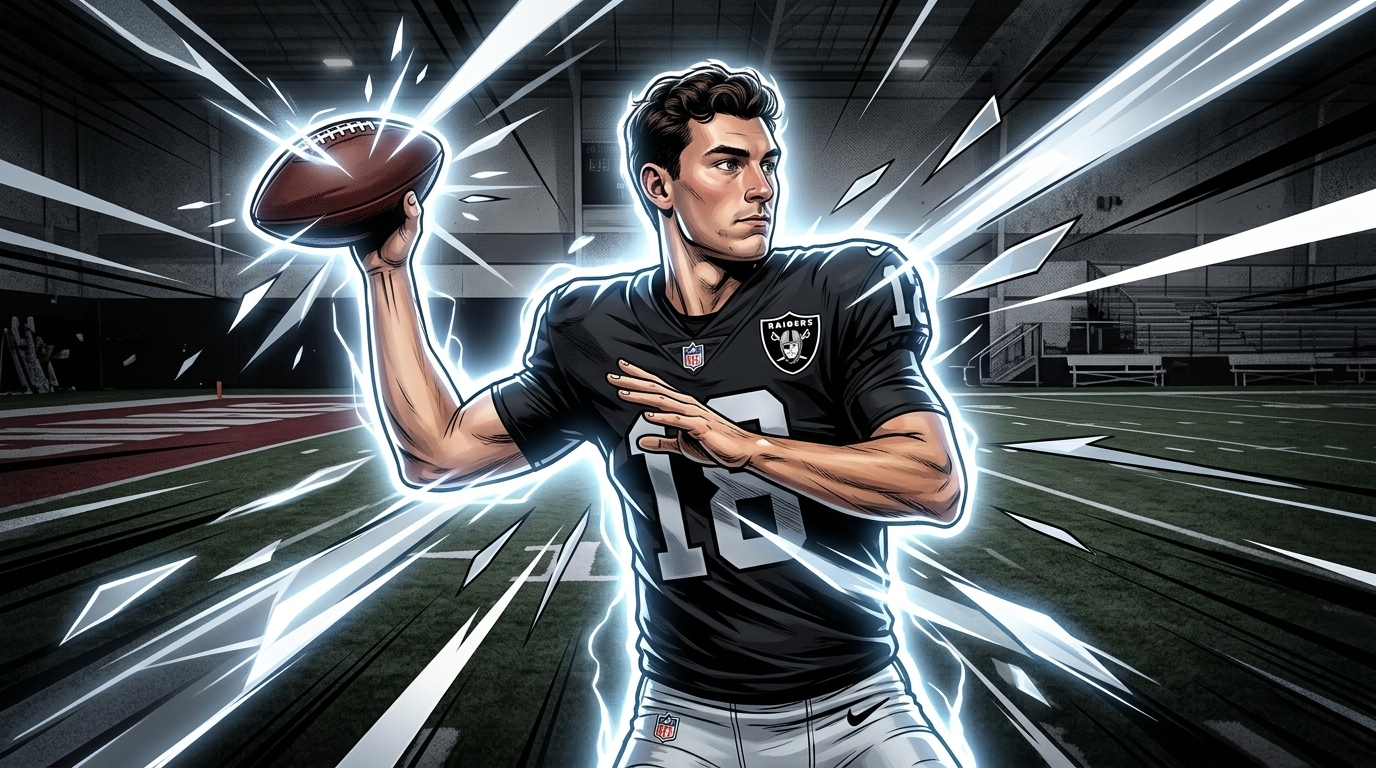
Klint Kubiak drafted a quarterback who went 16-0 last season and won the Heisman with the No. 1 overall pick, then opened training camp by naming a 37-year-old the starter over him instead — a call that only makes sense if you forget the Raiders already made it once, back in April. “When we go out to practice tomorrow, Kirk Cousins is the starting quarterback,” Kubiak told reporters, and Fernando Mendoza’s rookie season became a rep-share footnote before he’d taken a single camp snap.
Call it a competition if that helps. The Raiders signed Cousins on April 2 to a deal guaranteeing him $20 million this year, at a moment when reporting already had Las Vegas widely expected to draft a quarterback with the No. 1 pick three weeks later. They took Mendoza anyway. Cousins getting the nod now isn’t a performance evaluation — it’s the front office protecting a sequencing decision it made before it even had the pick: sign the bridge veteran, then draft the true QB1, then act like the two moves don’t argue with each other.
Mendoza finally got his contract sorted out once camp opened:
https://twitter.com/AdamSchefter/status/2080335356541411717
Fifty-seven million guaranteed for a rookie the team says it isn’t rushing is a strange amount of money to spend on patience.
The developmental case deserves a real hearing before it gets buried under the sequencing complaint. Kubiak, GM John Spytek, and minority owner Tom Brady all subscribe to the same philosophy: rookie quarterbacks develop faster sitting behind a competent veteran than getting rushed into the lineup in May. Cousins posted a 76.0 PFF grade last season, 14th among 43 qualified passers, exactly the profile of a bridge starter who can hold a seat without wrecking a season. Through the offseason program he took the bulk of the first-team reps while Mendoza and Aidan O’Connell ran with the second and third units, and Kubiak has said the reps could shift toward Mendoza by late August. Sitting a rookie behind a veteran while he learns an NFL offense is a real coaching plan, not an alibi.
It is also not the plan you would run if the front office actually believed the No. 1 pick was ready to start right now, and the Raiders apparently do believe that, because they handed him $57.2 million fully guaranteed to prove it.
Mendoza is projected for under 50% of first-team reps as camp opens, and that number is doing more work than a scouting report. Mendoza’s under-50% rep share isn’t really about performance. Cousins is protecting a decision Vegas already made twice — once by signing him assuming a rookie quarterback was coming, and again now, by keeping that rookie’s reps capped so the first decision doesn’t look premature.
I’ve watched Kubiak’s presser clip twice now, and the “he deserves it” line still doesn’t answer the question nobody asked him: why sign the bridge if the destination was never in doubt.
Cousins is favored to start Week 1 against Miami on September 13, though Mendoza’s preseason snaps against Arizona on August 13 could still move that number. Atlanta’s own quarterback non-competition looked just as settled last year before it wasn’t, and another rookie QB getting the slow-play treatment is happening in Cleveland with Shedeur Sanders. Anyone tracking the biggest training camp battles across the league this summer will find the same pattern: teams that already know the answer, taking the long way to say it.
Kubiak wants Mendoza and O’Connell to push Cousins because, in his words, “he’s played really good football.” Fine. But the real quarterback decision in Las Vegas got made in April, with a checkbook, three weeks before the draft made it look complicated.
The Raiders didn’t draft a developmental quarterback. They drafted a receipt for a mistake they haven’t admitted yet.