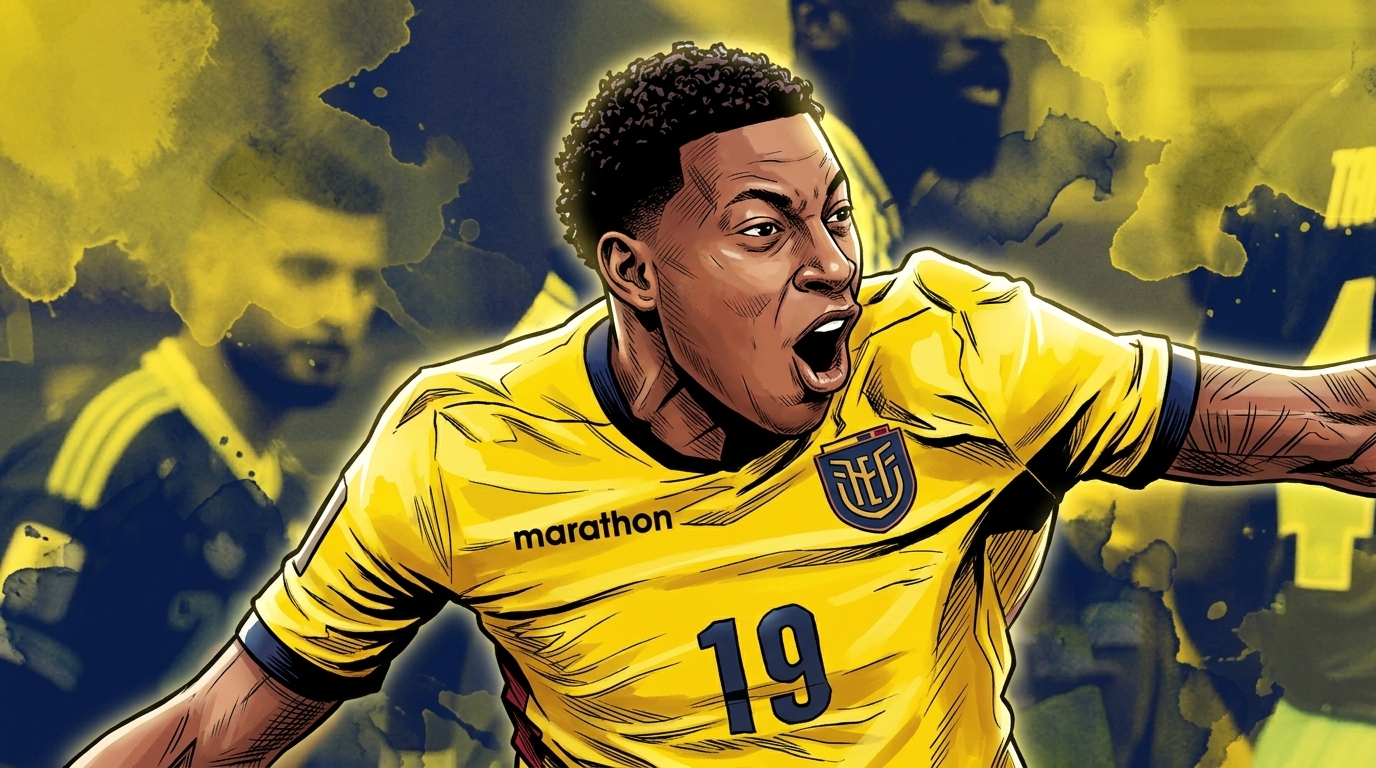

Gonzalo Plata nipped in front of Manuel Neuer at the 77th minute and prodded the ball into the roof of the net, and the Ecuador fans who’d packed MetLife Stadium in yellow — 80,663 of them — turned the building into something Germany had never faced before in this tournament: a wall of noise that wasn’t going away.
That’s the story of this Ecuador Germany World Cup 2026 match. Germany lost 2-1 in a Group E game that they’ll spend the next two weeks mis-explaining.
The VAR narrative has already calcified. Aleksandar Pavlović’s high boot appeared to catch Pedro Vite’s face on a throw-in in the second minute, immediately before Leroy Sané’s opening goal. VAR official Joe Dickerson reviewed it and let the goal stand. Ecuador’s players were furious, and understandably — the contact looked real. But here’s what the ESPN match blog also recorded: Germany had a penalty overturned in the second half when VAR caught Sané fouling Vite in the buildup to the foul that earned the spot kick. The same system that allegedly cost Ecuador in minute two took Germany’s penalty away in minute sixty-something. If you’re building a VAR conspiracy, it doesn’t hold.
What does hold is this: Nilson Angulo equalized in the ninth minute — Ecuador’s first goal of the entire tournament, on their 40th shot attempt across three matches — and from there Germany never looked like a team capable of controlling what was in front of them. Joshua Kimmich said after the match that “the opponent wanted to win more than us…especially in the second half.” Julian Nagelsmann said there was “too much freestyle.” These are not the quotes of a program that got robbed. These are the quotes of a program that watched Ecuador come alive and had no answer for it.
Ecuador’s path here was brutal. They went scoreless in their first two matches — a 1-0 loss to Ivory Coast and their scoreless group stage slog against Curaçao — and advanced as one of the eight best third-place finishers in a 12-group format. This is precisely what the 48-team World Cup was designed to produce. Not guaranteed chaos, but the structural possibility of it: a team that clawed through the group phase half-dead suddenly alive in a knockout environment, running at Germany in the 77th minute with nothing left to lose.
https://twitter.com/PopBase/status/2070260484536988069
I watched the Plata goal live and the thing that struck me was how routine it looked — a corner, a flicked header from substitute Kevin Rodríguez, and Plata arriving at the back post before Neuer could adjust. Nine international goals now. Flamengo player, 25 years old, second knockout stage appearance in Ecuador’s history. The moment wasn’t spectacular. That’s what made it devastating.
https://twitter.com/TouchlineX/status/2070266863037342079
The 48-team format isn’t Germany’s problem. Their problem is that they’ve now lost in the group stage in 2018 and 2022, and this time around they won the group despite losing to Ecuador — which actually tells you something about the format’s design. Germany were never in danger of elimination. But Germany’s 7-1 demolition of Curaçao was the number everyone leaned on when arguing Germany had rediscovered their identity. One blowout of a Caribbean nation that had never played a World Cup game before June was always going to be an incomplete data point. Ecuador’s defensive collapse in the first two matches was also an incomplete data point. The 77th minute is where the real data lives.
Enner Valencia, 36, Ecuador’s captain and all-time leading scorer, came off as a substitute. Likely his final World Cup. He didn’t score. His team made it to the Round of 32 without him. Germany’s program, on the other hand, is heading to Foxborough to defend its group-winning record against a knockout field that has been watching them for a week now — watching Nagelsmann’s complaints, watching Kimmich’s quiet admission, watching a team that beat Germany 2-1 play like they had nothing to prove and ended up proving everything.
The VAR controversy will dominate the next 48 hours. Germany will let it.