
The tweet was already written before Kai Havertz scored his first goal; the format critics had their take loaded in the chamber the moment the Group E draw was announced, and the Germany 7-1 Curaçao World Cup 2026 result was simply the occasion on which they fired it.
https://twitter.com/ZwebackHD/status/2066240822488523064
The logic here is a trap so elegant it almost deserves admiration. “Can you imagine a serious team losing 7-1 to Germany before all these new teams were let in?” Yes, actually. You don’t need to imagine it. You just need a history book. Germany dismantled teams in every previous format. The 48-team expansion didn’t create the talent gap between Germany and Curaçao; it created a group stage slot where that gap was on primetime television. Those are different problems. One is a football problem. The other is a scheduling and broadcast problem, and conflating them is the easiest thing in the world to do when you already have the tweet half-typed.
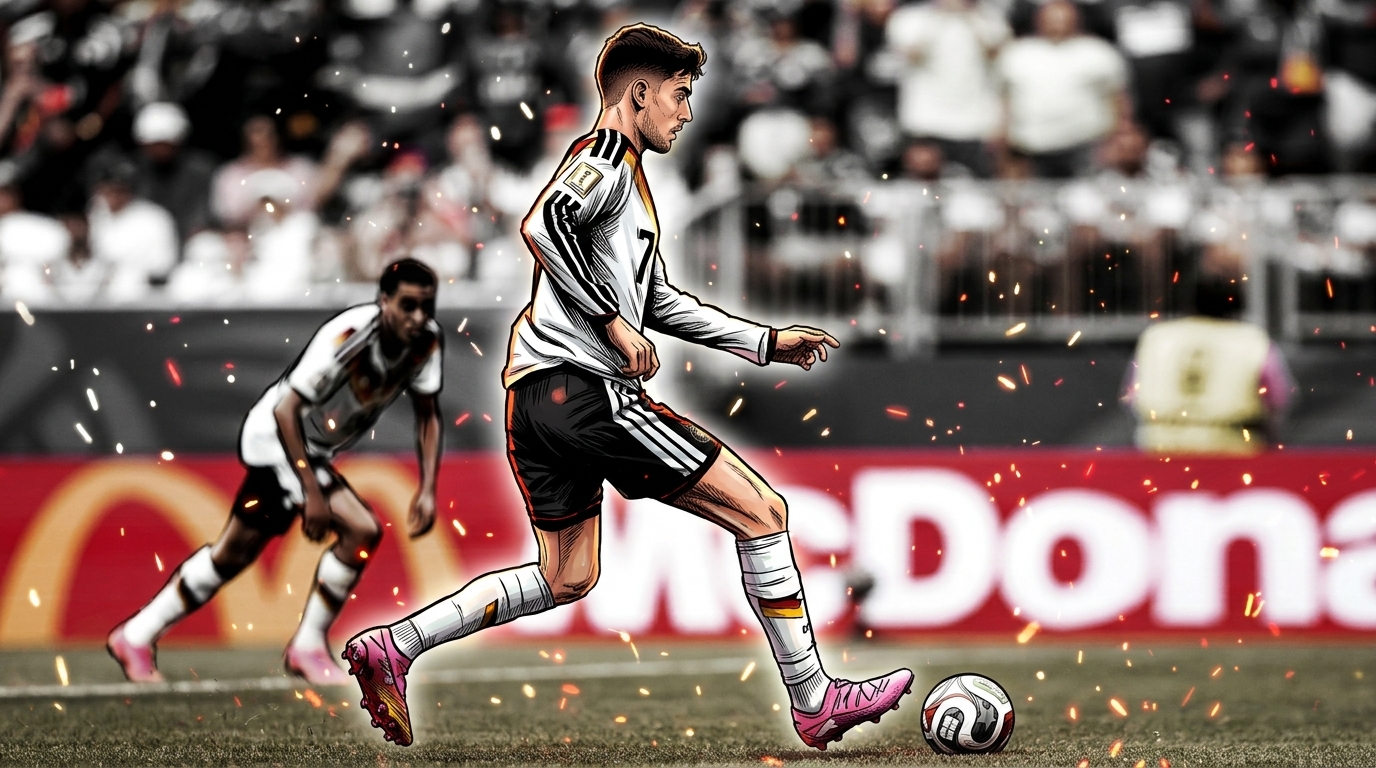
What happened at NRG Stadium in Houston on June 14 was not a referendum on FIFA’s expansion ambitions; it was a fairly accurate representation of what Germany does to teams that are not Germany. Felix Nmecha scored six minutes in. Nico Schlotterbeck headed home a corner in the 38th. Havertz buried a penalty before halftime. Jamal Musiala — who is so good at football that watching him play a team that is not very good at football feels like attending a knife-throwing demonstration where the target is a watermelon — swept in a through-ball from Joshua Kimmich in the 47th minute. Nathaniel Brown, Deniz Undav, and Havertz again rounded things out. Curaçao, for their part, scored through Livano Comenencia in the 21st minute; it was their first-ever goal at a World Cup, which is a genuine thing worth noticing, even if the scoreline immediately swallowed it.
The Musiala point deserves a beat. He scored once and spent the rest of the evening doing what he does: drifting, accelerating, making defenders look like they’d misread the weather. His one goal gave Bayern Munich the record for most World Cup goal contributions at 80, surpassing Real Madrid’s 79, which is either a meaningful statistic or a statistical artifact depending on how seriously you take club affiliation at international tournaments, but it’s the kind of fact that exists either way. Havertz was the actual top scorer on the night, with two goals; this detail was largely absent from a discourse that was already about something else.
And then there is Manuel Neuer, who is 40 years old and stood in goal for a 7-1 victory and touched the ball roughly as often as a garden ornament. The question of whether that constitutes the greatest or most boring shutout of his career is genuinely unresolvable; what’s not unresolvable is that his presence at this World Cup, at this age, in this condition, is more interesting than anything the format critics were saying. He didn’t have to do a single thing. The watermelon never got near the thrower.
The uncomfortable second layer of the 48-team discourse is that expansion doesn’t produce blowouts. Talent gaps do, and they have existed at every World Cup in every format. Yugoslavia beat Zaire 9-0 in 1974 with sixteen teams. The format puts more of these mismatches into primetime slots, which is a real and fair criticism of how FIFA scheduled group play; but “Germany was always going to do this to someone” is a sentence that would have been equally true in 1998, 2014, or any other year. The argument worth having isn’t whether Curaçao belongs at a World Cup. It’s whether FIFA, having decided they do belong, put them in the wrong group at the wrong time with no room to hide.
You can follow all of this and more in our ongoing World Cup coverage — where the format takes a back seat to the football — and catch up on everything else in soccer coverage that actually happened on the pitch. The result is in the books: Germany 7-1 Curaçao World Cup 2026, a scoreline that tells you everything about the talent gap and nothing at all about whether the right team is to blame for it existing.