
In Formula 1 pace modeling, one fast lap doesn’t mean anything. Two is a coincidence you can still argue away. Three, under different track conditions with different drivers, is a real number, and that’s when you start building the model around it.
NFL front offices just handed data guys like me a real number. Down in Atlanta, the Falcons ended a training-camp standoff by finalizing Bijan Robinson’s record running back deal. Up in Baltimore, Zay Flowers tying Justin Jefferson’s money became official days later. And in New Orleans, the Saints closed the third and biggest deal of the trio: a four-year extension worth up to $132 million for Chris Olave, with $90 million guaranteed through 2030, making him the sixth-highest-paid wide receiver in the league, per Yahoo Sports.
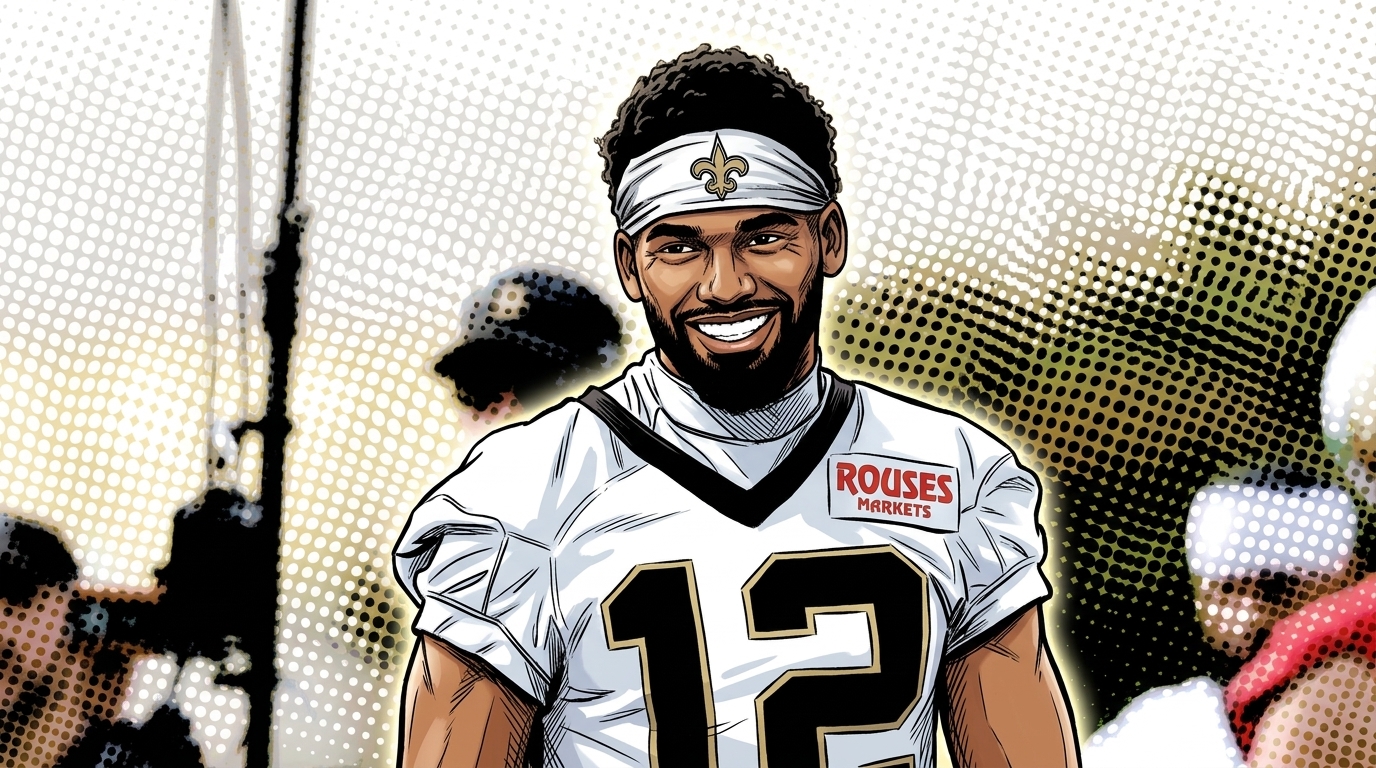
All three got done the same way: not with a holdout, where a player skips the building entirely and racks up daily fines, but with a hold-in, where he shows up, signs in, stands on the sideline in shorts, and does just enough to avoid the fine while his agent works the phones. Olave reported to Saints camp when it opened and stuck to individual position drills and walkthroughs, never taking a full-team rep until the deal was signed. The number is the headline. The tactic that got him there is the actual story.
Why Did the Hold-In Beat the Holdout?
A hold-in beats a holdout because it applies the same pressure without the fines a true holdout triggers, and it keeps the player physically in the building and visibly ready to play the second a number gets agreed to. A holdout burns bridges a hold-in never has to.
That math changed with the 2020 CBA, which stripped teams of the ability to waive holdout fines for anyone already on a second contract. Before that, a team that wanted to keep peace with a disgruntled veteran could simply eat the daily penalty. Now the fines stick automatically, which turned the true holdout into an expensive, mostly symbolic form of protest for anyone not still on a rookie deal.
Commanders receiver Terry McLaurin ran the expensive version last year, and it still worked, eventually. He opened as a full holdout, downgraded to a hold-in once the fines piled up, escalated to requesting a trade when Washington wouldn’t budge, and settled for a three-year, $96 million extension, an average of $32 million a season that tied him for sixth-highest-paid receiver at the time, per CBS Sports and NBC Washington. McLaurin got paid. He also spent a summer burning goodwill he didn’t need to burn, which is exactly the detour Olave, Flowers, and Robinson skipped.
There’s also a roster-construction angle a front office has to weigh that a fan watching from outside doesn’t always see. A trade demand forces a team to shop its own disgruntled star and set a public price on him, which is a bad negotiating position no matter how it resolves. A hold-in never forces that choice. The player is still in the building, still catching walkthrough reps, still available the moment a number gets agreed to, and the team never has to decide whether it’s actually willing to move him. That’s a quieter kind of leverage, and it’s exactly why three front offices folded to it inside the same two weeks.
What Does Olave’s $132M Actually Buy the Saints?
The $132 million buys New Orleans its most productive receiver in nearly a decade and locks him in before he gets more expensive. Olave posted a career-high 100 catches for 1,163 yards and 9 touchdowns last season, earned second-team All-Pro honors, and finished sixth in the league in targets with 151, according to Yahoo Sports.
https://x.com/AdamSchefter/status/2082940104520171641
That production came with a caveat the Saints didn’t ignore. Olave missed the regular-season finale with blood clots in his lungs, and general manager Mickey Loomis has said the health history, not just the leverage math, shaped how the deal got structured, per ESPN. This wasn’t purely a front office getting outmaneuvered by a hold-in; it’s a team paying a receiver it believes in while managing real medical risk on a four-year book.
Even with that caveat, $132 million over four years is the largest contract the Saints have handed a wide receiver since Michael Thomas signed his in 2019, per ESPN. Thomas’s deal became one of the more cautionary tales in recent Saints history once injuries piled up in the years that followed. Loomis knows that history better than anyone in the building. He signed Olave anyway, which says more about how much the front office trusts the tape over the medical file than any hold-in leverage did.
Is This a Pattern or a Coincidence?
This is a pattern, not a coincidence, because three separate front offices facing three separate hold-ins in the same camp week all reached for the same solution instead of digging in. Coach Kellen Moore’s comment doubles as the league’s new operating manual: “Communication is the key. As long as we all communicate and we’re all on the same page.”
Run the sample size the way you’d run it in any other dataset. One team paying up under a hold-in is a data point. Two is worth watching. Three, across two positions and three franchises, in the same two-week stretch, with a 2025 precedent already pointing the same direction, is a trend an agent can build a negotiating strategy around. I didn’t expect all three to land in the same camp window; running back and two different receiver markets don’t usually move together like that. Olave reportedly said before the deal, “I feel like we going to come down to that before training camp. I hope we do so we don’t affect the chemistry.” He was right, and he didn’t even need the trade request McLaurin needed to get there.
Every veteran heading into a second contract next offseason just got a new script: show up, stay ready, skip the reps that matter, and let the front office do the math on what a real holdout actually costs everyone involved. The players who still try the expensive version next summer will be making a choice, not a mistake, because the cheaper option is sitting right there in black and gold ink out of New Orleans.