
The bill arrived on June 1st, and the wrong person paid it.
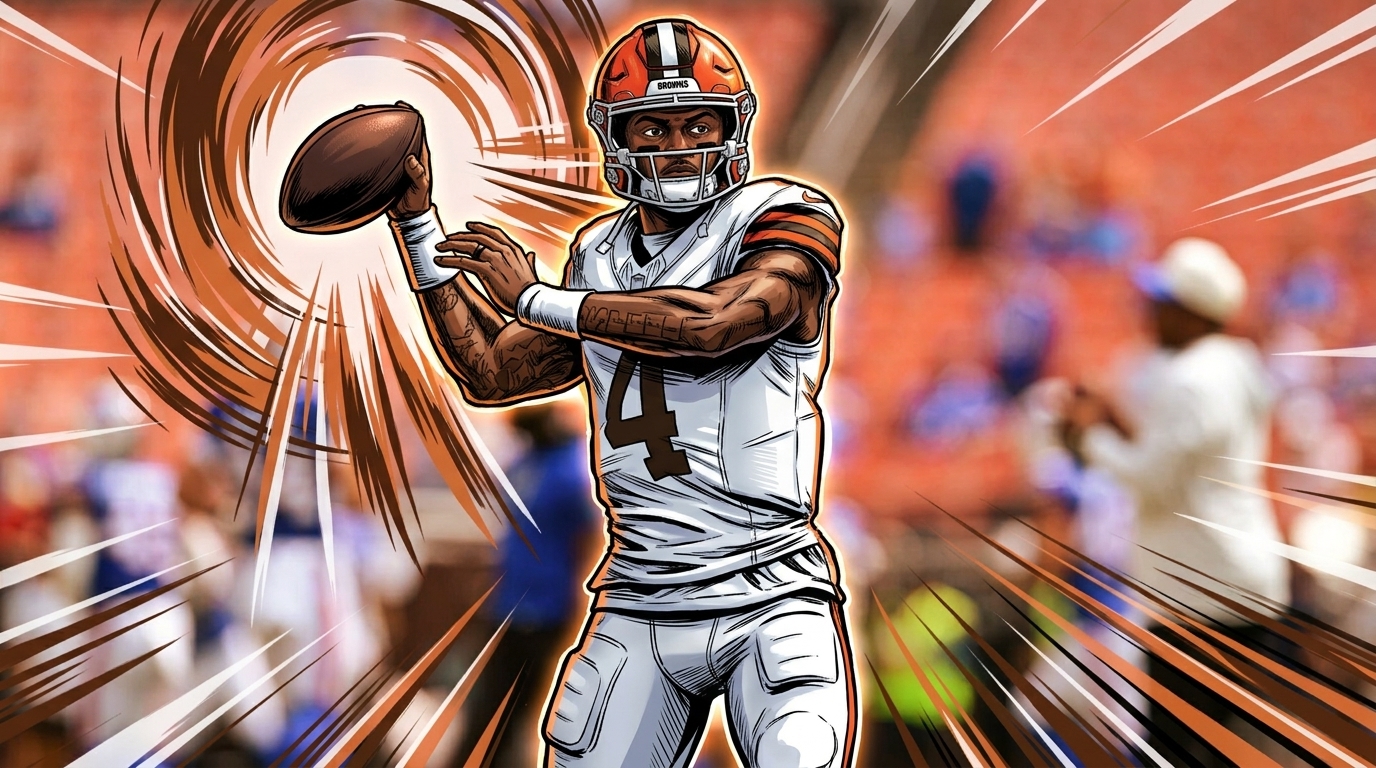
That is the entire Myles Garrett trade, collapsed into twelve words. Someone at the Browns spent $230 million fully guaranteed on a quarterback who played 19 games in four seasons. The money was locked in, immovable, accruing dead cap the way debt accrues interest — slowly at first, then all at once. By 2026, the Cleveland Browns were staring at $80.7 million in cap space consumed by a quarterback who hadn’t taken a meaningful snap in two years. The tab for that decision comes due in 2027 as $86.2 million in dead money, split across two years, the final receipt for an era that cost the franchise its best player without winning a single playoff game.
Myles Garrett didn’t run up that tab. He sat across the restaurant from it, ordered water, and tipped 20 percent anyway.
What Garrett did instead: 125.5 career sacks — more than any Brown in franchise history. A single-season NFL record with 23 sacks in 2025. Two consecutive Defensive Player of the Year awards. Five first-team All-Pro selections in six seasons; six straight Pro Bowls. He was drafted first overall in 2017 and spent nine years trying to will a structurally compromised organization toward something that looked like relevance. The Browns couldn’t get out of their own way long enough to build a team around him; the evidence of that failure is a $230 million contract for a quarterback who won nothing with it.
That’s how you end up trading a two-time DPOY.
The structure of the deal is not without logic. The Browns receive Jared Verse — 25, Defensive Rookie of the Year in 2024, 12 sacks and 22 TFL in his last two seasons, cost-controlled through at least 2026. They also get a 2027 first-round pick, a 2028 second, and a conditional 2029 third. By timing the trade after the June 1 deadline, Cleveland banked roughly $30 million in cash savings. General manager Andrew Berry called Verse “a perfect DNA match for our attacking front.” Berry said the opportunity was too great. He noted, with apparent sincerity, that “all of our goals are still in front of us.”
This is technically possible. The picks are real. Verse is legitimately talented. If you squint at the asset column for long enough, the transaction has internal coherence. But acknowledging the return’s quality doesn’t change what generated the need for the trade in the first place; it just means the Browns got reasonable value for a mess of their own creation. Getting fair compensation for burning your house down does not mean you didn’t burn your house down.
Berry also told reporters the Browns were not shopping Garrett. “That was not the intention,” he said — a statement that is true and entirely beside the point. You don’t have to be shopping a player to find yourself unable to afford him. Franchises that make quarterback decisions that haunt franchises for years don’t always look like they’re in crisis; they look like they’re managing assets, acquiring cost-controlled talent, optimizing cap space. The vocabulary of front-office competence and the vocabulary of front-office failure are almost identical, until they aren’t.
https://x.com/ClutchPoints/status/2061606832552976856
Garrett’s farewell landed like a letter written by someone who understood exactly what happened and chose grace anyway. “Cleveland made me tougher,” he wrote. “You taught me about perseverance, about showing up even when things aren’t easy, and what loyalty really looks like. Loving you is easy, leaving is the hardest part.” Then: “I wish I could have done more for you.”
He had 125.5 sacks. He broke the single-season record. He won the award twice. Myles Garrett leaves as the Browns’ all-time sack leader, which is a distinction that belongs entirely to him; the team’s failure to capitalize on it belongs entirely to someone else.
Watson’s dead money forced the Garrett trade. That sentence is what every other sentence in every press conference was carefully arranged to avoid. The Browns will call this a retool. They will talk about Verse’s athleticism, draft capital, cap flexibility. None of that is false. The Haslams said Garrett “will always be a Cleveland Brown,” which is the nicest thing you can say to a player you just handed to the Los Angeles Rams because you couldn’t afford to keep him.
For more on the league’s most consequential moves this offseason, follow our NFL coverage.
The Browns have done this before. It tends not to go the way they describe it.