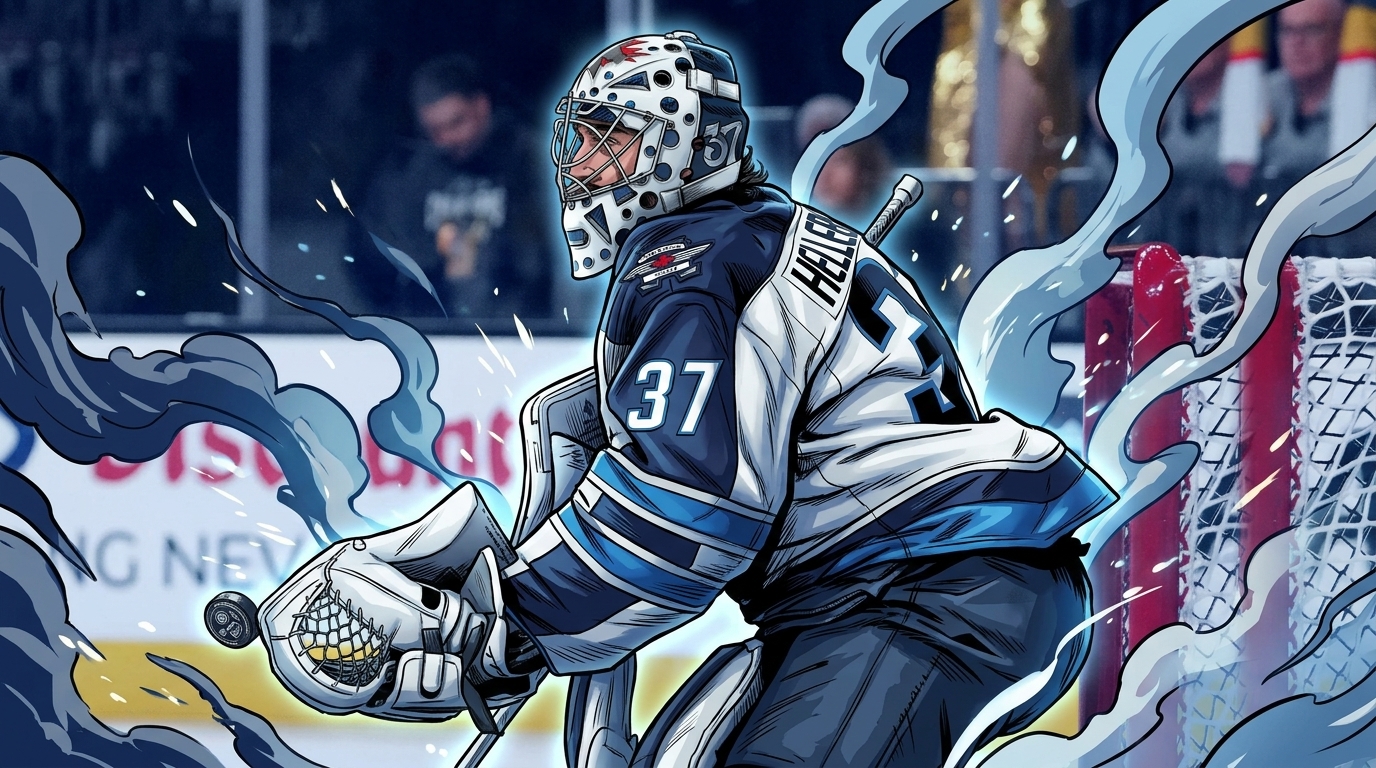

Sergei Bobrovsky posted a .877 save percentage last season. The league average was .896. That 19-point gap placed him in the bottom quartile of goalies who started 40 or more games. His goals saved above average, per Hockey-Reference, was -23.4. Meaning Florida gave up 23 more goals than expected because of him, not in spite of him. The Panthers missed the playoffs.
On July 1, 2026, the Toronto Maple Leafs signed Bobrovsky to a three-year contract at $7 million per year.
https://x.com/lukefoxjukebox/status/2072380956187484540
The data here is unambiguous. Toronto just bought ages 38, 39, and 40 from a goalie who is already tracking below where the aging models say he should be. This isn’t a calculated risk — it’s a pattern. And the pattern is the story.
What .877 Actually Means
Save percentage gets dismissed as a blunt instrument, so let’s be precise about what .877 means in 2025-26.
Per TSN, the NHL-wide average last season sat at approximately .896 — already a 30-year low, reflecting how hard it has become to stop modern shot quality. Against that baseline, Bobrovsky’s .877 wasn’t a minor slump. It was 19 points below a suppressed league average, which compounds the problem: you’re not measuring against a high bar, and he still fell well short of it.
The career arc makes it harder to explain away. Bobrovsky won the Vezina in 2016-17 with Columbus, posting a .932. As recently as 2023-24 with Florida, he was at .915 — genuinely elite. Then came a 38-point plunge to .877 in a single off-season, not a gradual erosion but a cliff. His -23.4 GSAA confirmed the eye test wasn’t lying.
Hockey Graphs’ aging curve research — work that’s been cited in front offices for over a decade — projects a steep goalie decline after age 35. A starter at .920 at age 35 reaches approximately .907 at 37 and approximately .885 at 40. Bobrovsky, at 37, is already at .877. He’s running ahead of the pessimistic projection on the way down. Toronto just committed $21 million to his age-38, age-39, and age-40 seasons with a full no-move clause.
Why Did the Maple Leafs Sign Bobrovsky?
This is the question worth sitting with, because the obvious answers are weak.
Name recognition explains some of it. Bobrovsky has two Vezinas, a Stanley Cup Final appearance in 2022-23, and a reputation built across a decade of genuinely excellent play. Decision-makers who watched him carry Florida to the brink of a championship three years ago may be anchoring to a version of him that no longer exists.
The playoff résumé is the only serious argument in his favor. In 2023-24, he posted a .915 in the regular season — genuinely elite. The year before that, despite a .901 regular-season mark, he elevated his game in the 2023 playoffs and carried Florida to the Stanley Cup Final. That’s the version of Bobrovsky that Leafs fans are imagining. The counterargument writes itself: those were three years ago, at age 34-35, before the decline accelerated. A goalie’s ability to elevate in the playoffs doesn’t age separately from everything else. His 2025-26 regular season offered no evidence that a playoff transformation was waiting underneath the numbers.
The NMC is harder to rationalize. It means Toronto cannot trade him without consent if the contract becomes unworkable — which, given the trajectory, is a meaningful probability by year two.
The Leafs Already Had Two Good Goalies
Here’s the part that sharpens the puzzle considerably.
Anthony Stolarz went .926 in 2024-25. He finished top five in Vezina Trophy voting. Joseph Woll posted a .909 across 42 games in the same season — strong enough that he would have been a legitimate starter on most teams in the league. Neither was injured. Neither was a pending free agent drama. Neither was a failure.
Toronto didn’t sign Bobrovsky to fill a void. They signed him to displace proven production for a 38-year-old in decline. If Bobrovsky plays as the clear starter — which the $7M AAV and the NMC both imply is the expectation — Stolarz and Woll become expensive backups or trade chips. The net goaltending quality of this roster almost certainly goes down.
For more on how the hockey world actually moved this summer, the contrast is worth reading. Check out our NHL coverage for the full picture.
What the Age Curve Tells Us About Ages 38 to 40
Let me be direct about the projection here, because it doesn’t leave much room for optimism.
The aging curve model was built on historical data across hundreds of goalie seasons. It isn’t a guarantee for any individual player, but it identifies the central tendency clearly: goalies degrade faster after 35 than most fans expect, and the deceleration compounds year over year. The model’s pessimistic band at age 40 is around .885. Bobrovsky is already below that floor at 37.
Some goalies age better than the model. Dominik Hasek was exceptional at 37. Marc-Andre Fleury remained functional well into his late 30s. But those are outliers cited precisely because they’re outliers. Citing them as evidence that Bobrovsky will defy his own numbers requires ignoring that his numbers are already worse than the model’s worst-case scenario.
The three-year length isn’t just expensive. It’s a window during which the Maple Leafs’ championship probability is presumably highest. If they believe this is their window, spending $21 million of it on a declining 38-year-old with no trade flexibility is a significant constraint on what else they can build around Auston Matthews and William Nylander.
A Pattern, Not an Accident
This matters beyond one signing because the Leafs have a traceable history of goaltending decisions that follow the same shape.
Petr Mrazek, signed with optimism, posted a .888 and was traded inside two seasons. Ilya Samsonov arrived and produced the best goaltending Toronto had seen in years — .919 in 2022-23 — then collapsed and was waived by December 2023. The pattern isn’t that Toronto’s goalies always fail. It’s that the organization consistently makes acquisitions that seem justified by reputation or recent peak rather than current trajectory and contract structure.
Stolarz and Woll broke that cycle. They were legitimately good last season, with no organizational dysfunction required to explain their performance. The Bobrovsky signing doesn’t build on that foundation — it bets against it.
The evidence suggests this will end the way the modeling says it will end. Toronto will spend three years managing an aging goalie on an immovable contract while two better options sit behind him or get moved to clear space. At 40, Bobrovsky will post numbers that nobody in the front office will be able to explain with a straight face.
They had the data. They had two good goalies. They signed Bobrovsky anyway.
That’s the pattern.