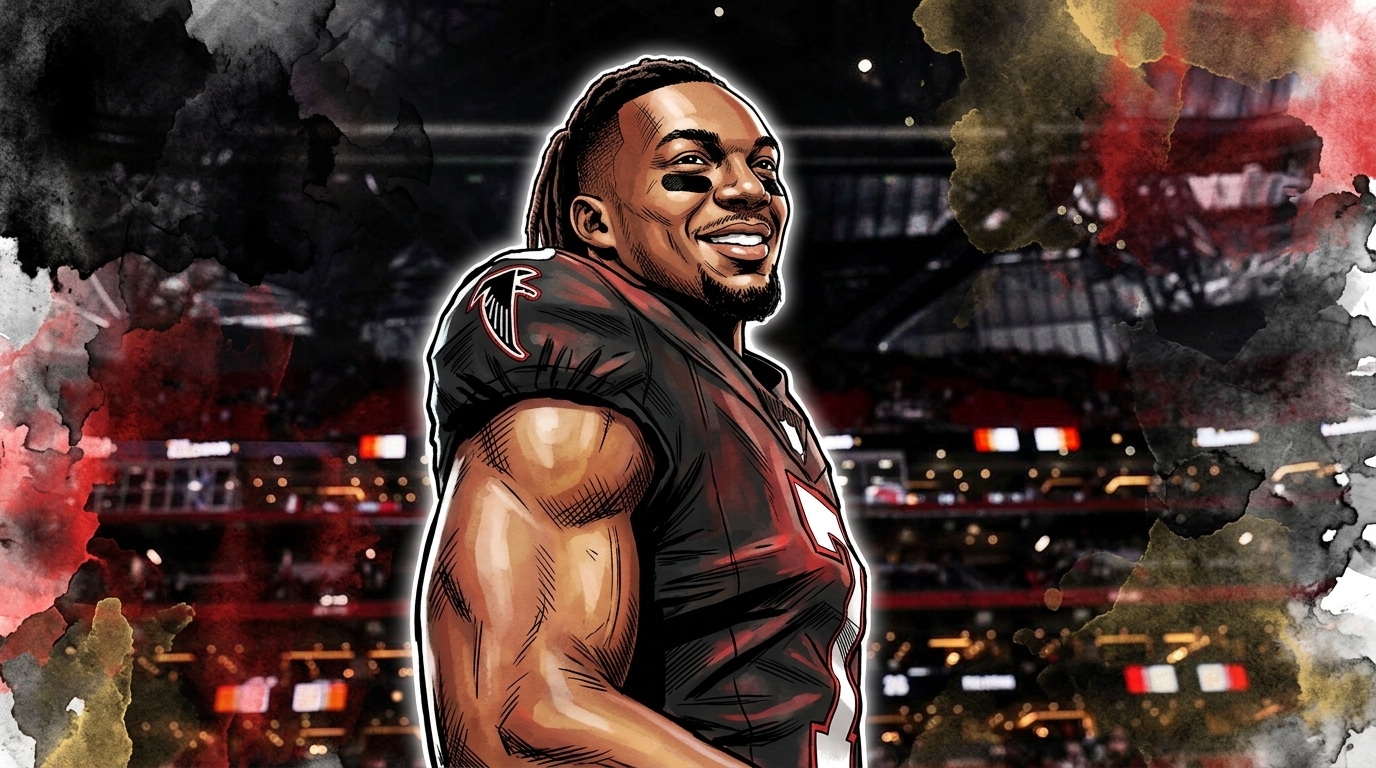

The most subversive thing Bijan Robinson can do when Atlanta Falcons training camp opens on July 29 is show up.
Not hold out. Show up. Run every route, take every carry, do every conditioning drill, and refuse to sign anything. This is the hold-in, and in 2026 it is the only leverage available to a running back under contract — which means it is also, paradoxically, the most powerful statement Robinson can make. You cannot penalize a player for being exactly where the collective bargaining agreement requires him to be; you can only watch him decline to make your contract problem easier to ignore.
The Falcons’ contract problem, to be precise. Robinson led the NFL with 2,298 scrimmage yards last season, made First Team All-Pro, was named to the Pro Bowl for the second time, and accounted for 48.2% of the team’s total offensive yards. His 2026 base salary is $1.145 million. The team exercised his fifth-year option in April, which locks him in at $11.323 million for 2027 and makes holding out financially catastrophic. So he will not hold out. He will arrive at the Flowery Branch facility, lace up his cleats, and decline to solve the organization’s extension math on the organization’s timetable.
CBS Sports’ Jonathan Jones had the official framing:
https://x.com/jjones9/status/2042701090353738162
A placeholder. That word is doing a lot of institutional work. A placeholder is what you put in a document when you intend to fill it in later, when the real answer exists but you haven’t gotten around to writing it down yet. It implies that a long-term extension is the inevitable destination and the fifth-year option is merely an administrative resting spot on the way there. The Falcons would very much like Robinson to accept this framing; Robinson is under no obligation to.
NFL Network’s Tom Pelissero reported that the team considers an extension a priority but described it as a waiting game — specifically, that whichever team signs its running back first (Detroit’s Jahmyr Gibbs is the comparable) will likely be surpassed by the next deal. That is an accurate description of how market-setting works; it is also a description of why the Falcons have every incentive to delay. If they can watch Gibbs set the market first, they can structure Robinson’s deal off an established floor rather than help establish one themselves. The savings are marginal and the math is insulting, but the logic is consistent.
The Falcons built their entire offense around a generational running back and then spent two seasons cycling through a quarterback situation that a competent front office would not have allowed to develop. Kirk Cousins and Michael Penix Jr. split starts in 2025; Penix tore his ACL in Week 11 against the Panthers; Cousins was released before 2026. Penix’s recovery timeline is uncertain. The Falcons enter training camp without a settled quarterback, with a running back generating nearly half their offensive production, and with the audacity to treat his contract extension as a market-timing exercise. This is roughly equivalent to a company deciding to benchmark its most valuable employee’s compensation against whatever competitors agree to pay first.
Robinson spent two years as the load-bearing wall of an organization that could not decide what to build around him. His per-game numbers, his context-adjusted production, his candidacy for a market-setting contract — all of it accumulated behind a quarterback room that suppressed whatever ceiling he might otherwise have reached. The Falcons are now using those numbers, accurate as they are, to justify a slower negotiating pace on a deal Robinson’s raw output already overqualifies him for. He generated 2,298 scrimmage yards and 34 career touchdowns in three seasons while his quarterbacks were, in the most charitable interpretation, a work in progress. You adjust for that, or you acknowledge that you are deliberately not adjusting for it.
My dad, a retired English teacher, has a rule about editing: if you have to explain why a sentence means what you say it means, the sentence is wrong. The Falcons’ current extension offer apparently requires a similar explanation. The market comps are real — Saquon Barkley at $20.6 million annually, De’Von Achane at $16 million, Breece Hall at $15.25 million — and Robinson’s ask of approximately $25 million per year is the logical conclusion of outperforming all of them. If the offer needs a placeholder, the sentence is wrong.
The people saying this gets resolved before the season may be correct. Pelissero was not reporting that talks had collapsed; the team has already extended Drake London and Kyle Pitts this offseason. The optimistic read is that Robinson is simply last on a reasonable offseason checklist, and the fifth-year option genuinely is a placeholder for something more permanent arriving in August. That reading does not change what Robinson should do between now and the moment a contract lands on his desk. Show up, do everything asked of him, and wait. Every day the Falcons watch 48% of their offense participate fully in camp without a signed deal is a day they are reminded of what they are asking him to accept. That is not a tactic. That is arithmetic.
The NFL running back market has been suppressed for a decade by a league that decided the position was fungible and priced it accordingly. Robinson is not just negotiating his own contract; he is participating in the ongoing argument about whether that suppression can be reversed. The Falcons are not going to enjoy being the test case. But they made this their problem first.