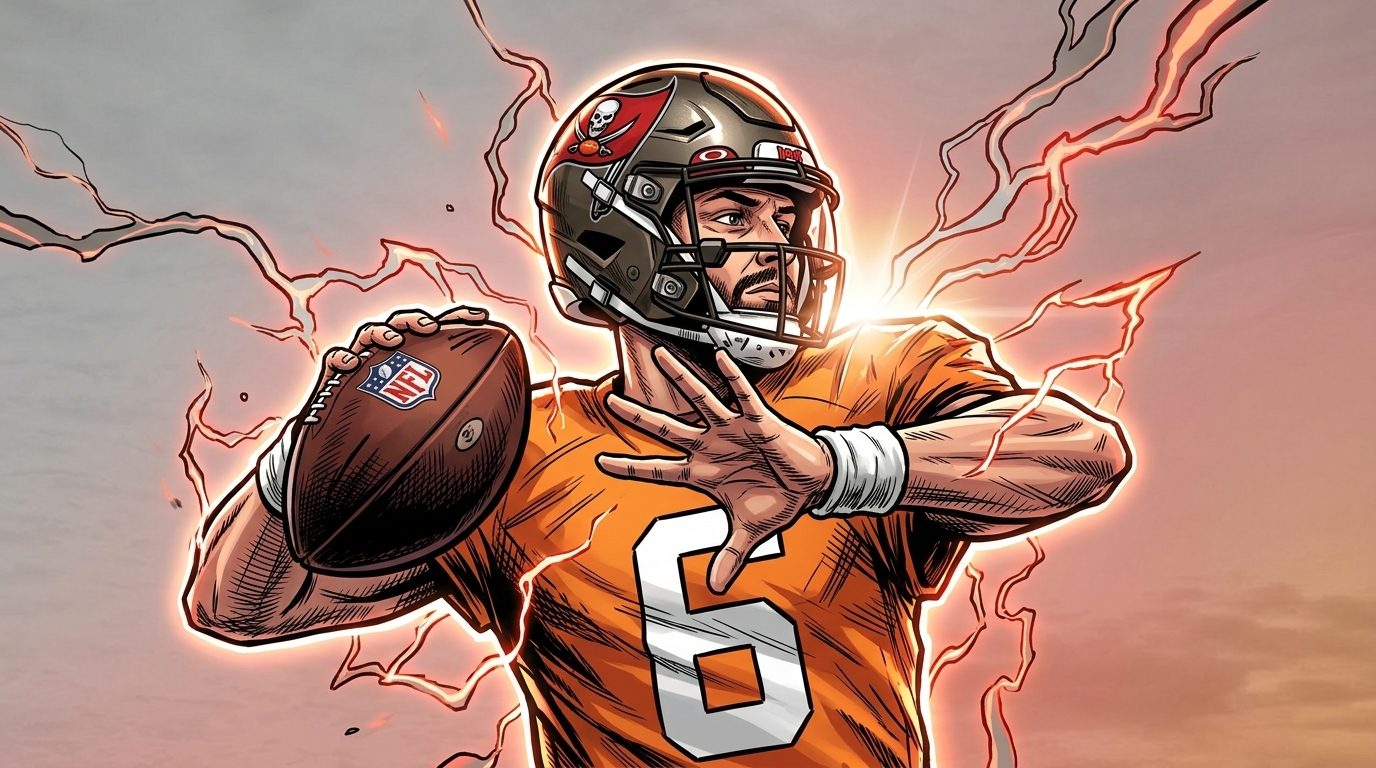

Baker Mayfield set a training camp deadline on his contract talks, called the gap “not anywhere close to what we were thinking,” and waited for Tampa Bay to flinch. Tampa Bay did not flinch.
This is the correct response from the Buccaneers, and it will stay correct until Mayfield actually walks.
The math here is unflattering to Mayfield’s position. His current deal averages $33.33M per year, which ranks him 16th among NFL quarterbacks by salary. Agents around the league have made clear the gap is substantial — this in a market where twelve QBs already sit at $51M or higher and Patrick Mahomes set the ceiling at $64M AAV. His agents want him compensated like a top-ten player. Tampa’s front office is looking at an 8-9 season and a missed playoff and thinking: no.
There’s a structural truth buried in this standoff that the NFL media conversation keeps dancing around: the market for “pretty good quarterbacks on back-to-back winning teams” is almost always exactly one team. The Cardinals, the Steelers, the Jets — columnists have floated all of them as potential trade destinations. There is no confirmed actual interest from any of them. Speculation is not leverage. And the Buccaneers have made clear they are “in no rush,” per Mike Garafolo’s reporting — a posture that only makes sense if they’ve already run the trade-market temperature check and found it cold.
I’ve been a Cardinals fan long enough to know what franchises look like when they panic. They overpay. They manufacture urgency. They convince themselves a player is irreplaceable three years before that player proves them wrong. Tampa isn’t doing any of that, which is either disciplined front-office thinking or a lucky accident — probably a little of both.
Back in May, the Buccaneers were still in full offseason optimism mode.
https://twitter.com/Buccaneers/status/2052390480483094671
The contract drama that followed aged that tweet considerably. But the sentiment Tampa is projecting now — calm, unhurried, mutually interested but unmoved — is probably the right one. Todd Bowles said he wants Mayfield long-term. GM Jason Licht said the same. Neither of them is behaving like a team that needs to close this before July 28. That’s notable.
Mayfield’s deadline framing — “as soon as training camp starts, we’re not doing any contract stuff, it’s all ball” — sounds tough until you realize it removes his own leverage. He’ll be in camp, playing for the same team, under the same contract, with the same 2026 cap hit of $39.975M already locked in. The deadline doesn’t pressure Tampa. It just ends Mayfield’s window to negotiate before the season starts. He has more to lose from that than they do.
The smart play for Mayfield is the one he’s least likely to take: show up, go 11-6, and let his play make the argument Tampa can’t ignore. Watching what happens when the team fails the quarterback is instructive — but so is watching what happens when a quarterback overestimates his market and burns the negotiating goodwill he actually had. The worst outcome here isn’t a failed extension. It’s Mayfield forcing a bad deal in the wrong direction, for both sides, because neither party could stomach the awkwardness of waiting.
Tampa’s shrug is the correct move. Mayfield’s deadline is theater. And the only audience buying tickets is the one that wants drama more than answers.
The curtain comes down July 28 either way — just probably not how Baker planned.