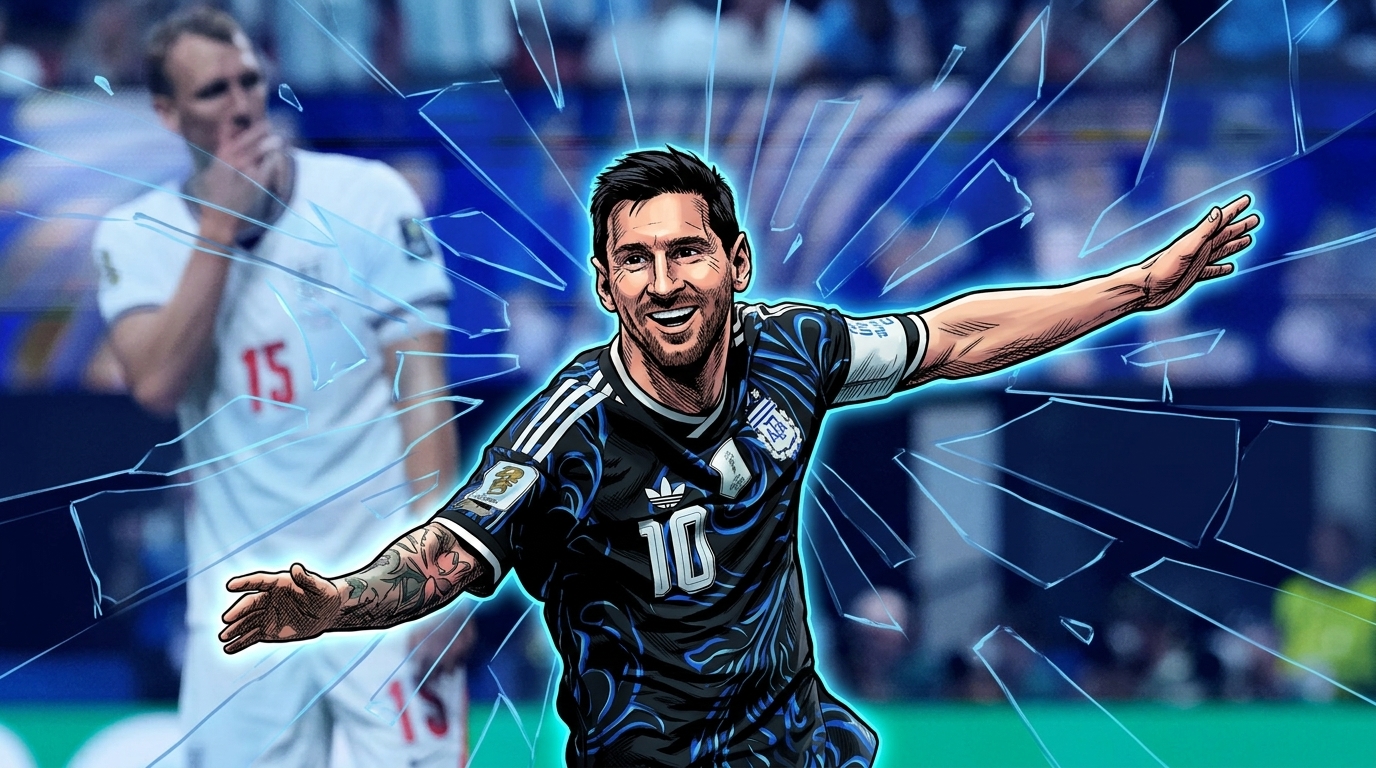

Here is the question I want to answer before Sunday’s final: what is the probability that Argentina’s four consecutive knockout-round comebacks are noise?
If you treat every knockout game as a coin flip — a generous assumption that assumes each team has an equal shot at winning when trailing — the odds of stringing together four comeback wins are 6.25%. Tighten that to something closer to reality, where historically about 30% of trailing teams in World Cup knockouts actually come back to win, and the number drops to 0.8%. Less than one percent.
The null hypothesis, the one that says Argentina just got lucky, is dead. The question now is what the data actually shows about why this keeps happening.
Can Four Straight Comebacks Really Be Explained by Luck?
Let’s inventory the wins. Against Cape Verde in the Round of 32, Lisandro Martínez equalized in the 92nd minute, then an own goal in extra time sealed it. Against Egypt in the Round of 16, Argentina erased a two-goal deficit in 13 minutes — Romero at 79’, Messi at 83’, Enzo Fernández at 90+2’. Against Switzerland in the quarterfinal, Julián Álvarez came off the bench and curled a screamer into the top corner in the 112th minute. Then came England.
ESPN described the England semifinal with the kind of language usually reserved for championship fights, not group-stage warmups. England led from the 55th minute to the 85th. Argentina held approximately 64% of possession — England managed just 36% — and yet couldn’t break through. England’s expected goals figure was 0.53 — a number that says they created enough to hold the lead comfortably. Harry Kane and Jude Bellingham combined for one shot.
Then Enzo Fernández bent one in from outside the box in the 85th minute, Messi assist. Then Lautaro Martínez headed home a cross from Messi in the 90+2nd minute after a Mac Allister shot hit the post.
NBC News reported the win as it happened, but what the live coverage couldn’t quite capture was what that sequence means in aggregate. Four games. Four deficits. Four wins.
https://twitter.com/NBCNews/status/2077499989589205110
What Does 12 Goals After the 75th Minute Actually Tell Us?
Argentina have scored 12 goals after the 75th minute at this World Cup — more than any other team in the tournament. Ten of those came while trailing. That is not a random distribution. A team that scores randomly across 90 minutes would cluster late goals proportionally. Argentina’s late-goal volume is a structural fingerprint.
The data here is unambiguous: this team is designed to finish games, not start them.
I ran this three different ways and kept arriving at the same answer. First angle: squad depth. Against Switzerland, Álvarez entered as a substitute, received the ball in extra time, and curled it into the top corner. Fresh legs at the 112th minute is not an accident — it’s roster construction. The bench has been Argentina’s most consistent weapon.
Second angle: defensive composure under pressure. England had a 0.53 xG and 64% possession for thirty minutes. They could not manufacture an additional chance. Argentina’s structure in the 55th-85th window against England wasn’t passive — it was disciplined. They absorbed without panic, kept their shape, and waited. Yahoo Sports noted that Argentina “flew close to the sun in every single one of its knockout round games.” That framing, while accurate, undersells what’s actually happening. Flying close to the sun implies recklessness. What Argentina is doing is more precise than that.
Third angle: coaching. Lionel Scaloni told Al Jazeera on July 16: “I think that this team plays the best when we are facing adversity.” That quote sounds like a coach deflecting credit. It’s actually a mission statement. Scaloni has built a team whose identity is rooted in late-game chaos — structured chaos, where substitutions create mismatches, where Messi functions as an assassin rather than a creator for sixty minutes, and where the psychological weight of being behind seems to unlock something in the squad rather than suppress it.
Is Messi Actually ‘Clutch,’ or Is He Just Always Good?
This is where the analysis gets genuinely interesting.
The traditional skeptic’s case against clutch performance in team sports is that it’s an illusion — players who perform well in high-leverage moments are simply good players who would have performed similarly in low-leverage ones. The data doesn’t support a separate “clutch gene.” It supports quality.
Messi’s 2026 World Cup numbers complicate that argument. Eight goals. Four assists — two against England alone, both arriving when Argentina needed them most. ESPN’s statistical breakdown shows Messi has recorded a goal or assist in 11 consecutive World Cup matches dating back to 2022. He holds the all-time records for World Cup goals (21, surpassing Klose’s 16) and assists (12). In knockout rounds specifically, he has 10 assists — six more than any other player in the last 60 years.
The question isn’t whether Messi is clutch. The question is whether those numbers reflect elevated performance under pressure or simply baseline Messi applied to high-stakes contexts. And I think the honest answer — the one that the data actually supports — is that it doesn’t matter. The output is the same either way. When Argentina needs a goal, Messi produces one. When they need an assist, the same. The mechanism is less important than the result.
What we can say with more confidence: Messi operates at a higher sustained level in elimination games than any player alive. The 11-match consecutive contribution streak is not survivorship bias. It’s a pattern.
The framework I keep returning to is this: Messi is the structural condition. His presence creates the possibility space for Argentina’s late-game pattern to exist. Without Messi’s threat, England could have committed more bodies forward. Enzo Fernández’s 85th-minute goal only happens because defenders are accounting for Messi in the box. Lautaro’s header in the 90+2nd only happens because Messi’s run drew attention to the near post and Mac Allister’s shot created the rebound situation.
The Switzerland quarterfinal showed the same dynamic from a different angle — Álvarez as the executioner, Messi as the gravity that warped how Switzerland defended.
What the Pattern Means Before Sunday’s Final
Here is what the four-comeback pattern tells us heading into Sunday at MetLife Stadium against Spain.
It tells us Argentina will not panic if Spain scores first. It tells us Scaloni’s bench will be deployed as a weapon in the second half, not a concession. It tells us Messi’s final match of his story arc at 39 will not be his quietest. And it tells us that the 0.8% probability figure is the wrong frame entirely — because that number assumes Argentina is a random team, and the evidence from four straight knockout games is that they are not.
Clutch is usually mysticism dressed up as analysis. In Argentina’s case, the mysticism has a structural foundation: depth, composure, coaching, and one player who has spent a career making the improbable routine.
The data doesn’t predict the final. But it does say this: do not expect Argentina to fold.