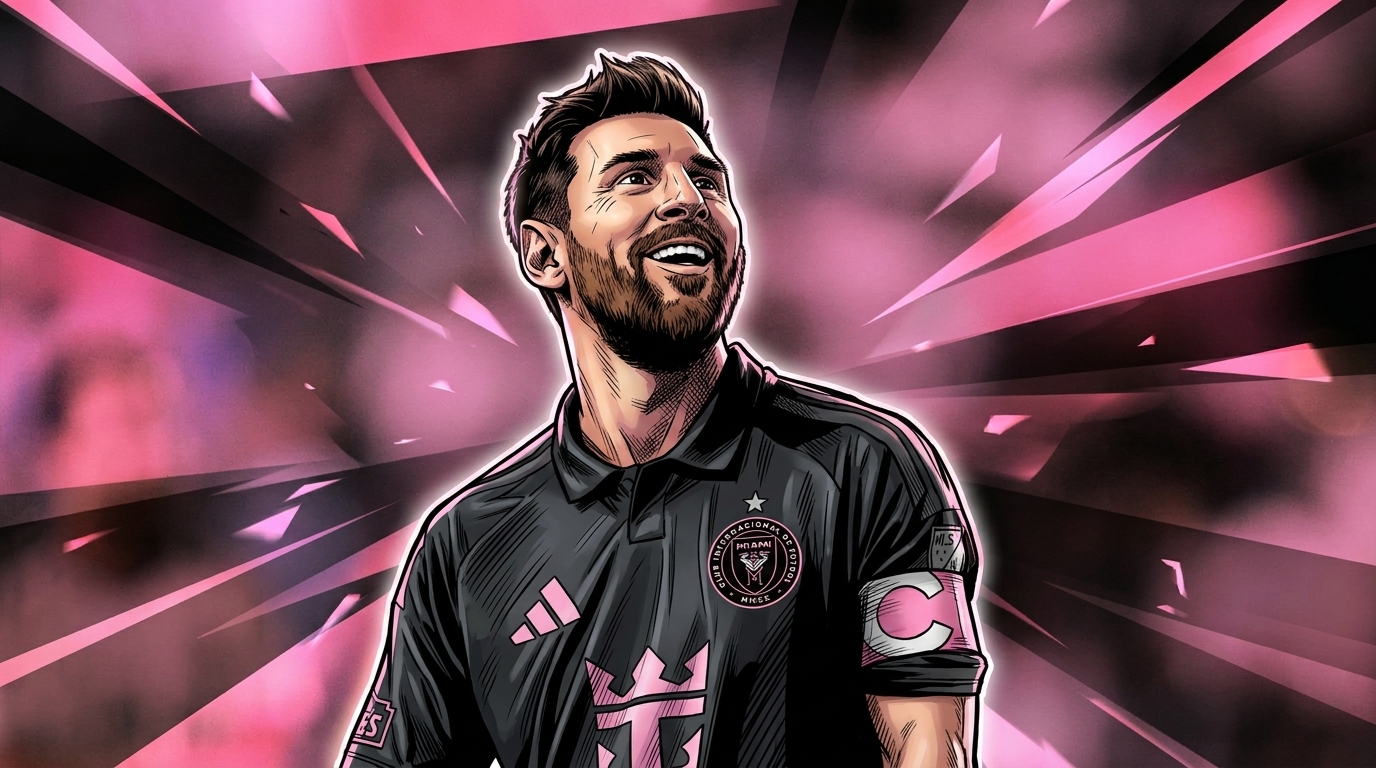

In late 2007, a twenty-year-old Lionel Messi sat in the dressing room at Camp Nou and held a six-month-old baby in a blue plastic bathtub. It was a UNICEF charity shoot. The baby’s name was Lamine Yamal. Yamal’s father posted the photo after the Euros. The caption: “The beginning of two legends.”
Sunday, at MetLife Stadium, those two people will try to beat each other in a World Cup final.
The sport is not subtle.
Messi is 39 years old, has eight goals in this tournament, and just led Argentina through four consecutive matches where they either trailed or were still level going into the final stages. Against Cape Verde in extra time. Against Egypt while two goals down. Against Switzerland, again in extra time. Against England on Wednesday, when Gordon put them behind in the 55th minute and Messi set up the equalizer in the 85th, then crossed for the winner in the 92nd. Four games. Four times Argentina had to find something they didn’t appear to have left.
“No matter how much it hurts or what people say,” Messi said after the semifinal, “this group keeps proving that nobody gives you anything on the pitch.”
I have watched the sequence leading to the England equalizer three times. What strikes me isn’t the execution — it’s the economy. Messi doesn’t run to the ball anymore. The ball runs to him. At 39, with whatever remains of his legs, he has figured out how to make the game move around him instead of chasing it. That’s not decline management. That’s mastery at a register most players never reach in their prime.
The all-time World Cup records he’s holding aren’t the point, exactly — though 21 goals across six tournaments, 10 knockout-stage assists, 11 consecutive World Cup games with a goal or assist, these are numbers that belong in a different conversation than the one happening around any other player alive. The point is what they describe: a career that has bent an entire sport’s history toward it, across decades, and still isn’t finished.
https://twitter.com/herculezg/status/2077504719094689863
Spain will be a different problem than England. Lamine Yamal — nineteen years old, third-youngest player ever in a World Cup final — is operating at a level that has made otherwise rational soccer writers reach for words they don’t normally use. The generational handshake the sport is performing in this final is almost too neat to be believed, which is probably why it’s real. The baby in the bathtub is now the opponent, and he’s good enough that Argentina cannot afford to simply survive.
“Reaching two consecutive World Cup finals,” Messi said, “is something very few achieve, and this group did it.” Back-to-back wins would make Argentina the first country since Brazil in 1958 and 1962. The aging framework that everyone reached for last year — the one about how long he could sustain this — is now sitting in a drawer somewhere, unused.
“I’m really very tired,” he also said after Wednesday, “just like my other friends.”
Thirty-three career World Cup goal contributions. Thirty-nine years old. One game left.
Whatever happens at MetLife on Sunday, we are watching the end of something that will not come again.