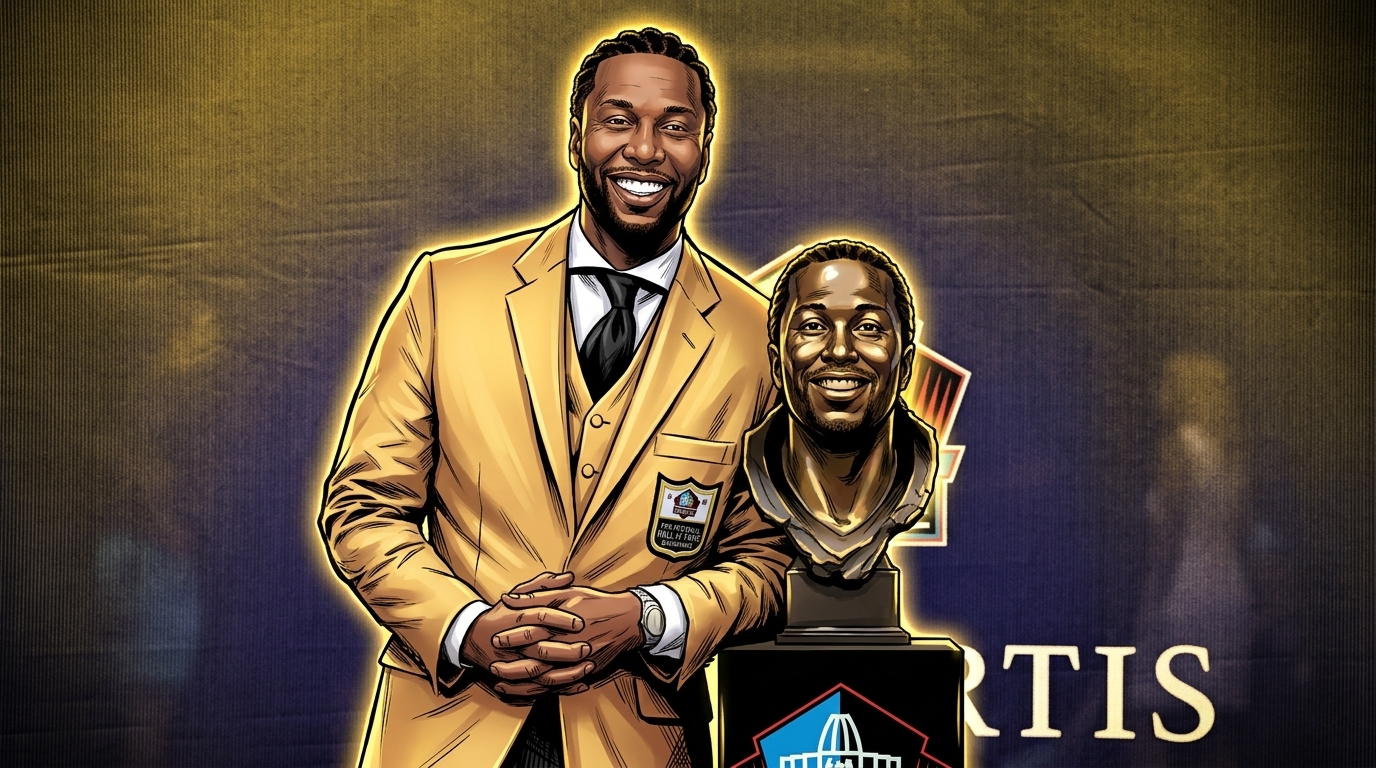

There’s a gap in every Hall of Fame class between the players a highlight reel leads with and the players who actually bent the direction of their position, and Canton spent Saturday’s ceremony pretending that gap doesn’t exist.
Drew Brees and Larry Fitzgerald are the two names carrying this weekend’s coverage, and by the time tonight’s recap shows finish cutting their highlight packages, that will feel like the whole story. The 2026 class is more complicated than that. Run it through what I’ll call the Blueprint Score, not who compiled the biggest numbers but who became the outline teams now draft, coach, and scheme around, and the order flips. Luke Kuechly, who retired in the shortest career of the five, ranks above two first-ballot locks. Roger Craig, who waited a quarter-century for a bronze bust, ranks above all of them.
Who’s Actually in the 2026 Hall of Fame Class?
The 2026 Pro Football Hall of Fame class is Drew Brees, Roger Craig, Larry Fitzgerald, Luke Kuechly, and Adam Vinatieri, enshrined Saturday in Canton, Ohio. Brees and Fitzgerald made it on the first ballot, Kuechly and Vinatieri needed a second year, and Craig waited through the senior committee for more than two decades.
Sean Payton presented Brees, his old head coach in New Orleans. Fitzgerald’s son Devin did the honors for his dad. Julius Peppers, Kuechly’s teammate in Carolina, spoke for him, Morten Andersen introduced Vinatieri, and Ronnie Lott and Charles Haley, Craig’s old San Francisco teammates, presented him together. The week around the ceremony had its own subplot: it opened with the Hall of Fame Game earlier this week and closed on a class that still had a hole in it, since Belichick and Kraft got left out of this class entirely again.
This is the class in the shape ESPN will keep running highlights of all weekend:
https://twitter.com/AdamSchefter/status/2086050160845459711
Thirty-eight combined Pro Bowl selections is a number built for a highlight reel. It’s also a measure of name recognition, not positional influence, and those aren’t the same ranking.
The Recognition Ranking Everyone Already Agrees On
Poll a casual football audience walking out of Tom Benson Hall of Fame Stadium and the order looks something like Brees, Fitzgerald, Vinatieri, Kuechly, Craig, and it’s not hard to see why. Brees threw for 80,358 yards, second all time behind Tom Brady, who passed him in 2021, with 571 touchdowns, 13 Pro Bowls, and the only Super Bowl title in Saints history, won over Peyton Manning’s Colts. Fitzgerald caught 17,492 yards and 121 touchdowns across 17 seasons, all of them in Arizona, and turned the 2009 playoffs into his own highlight reel: 30 catches, 546 yards, and seven touchdowns on the Cardinals’ run to Super Bowl XLIII. Vinatieri made 599 field goals, still the all-time record, and hit two Super Bowl-winning kicks for New England, the kind of moment that gets replayed every February no matter how old it gets.
Counting stats and Super Bowl moments are the currency of casual recognition, and Brees, Fitzgerald, and Vinatieri banked more of both than Kuechly or Craig ever got the chance to. That’s a real ranking. It answers a different question than the one that should decide who actually changed how their position gets played.
Why Roger Craig Ranks Higher Than His Ballot Speed Suggests
Craig needed the senior committee and more than two decades to reach Canton, which is its own kind of injustice given what he actually did. In 1985, he became the first player in NFL history to top 1,000 rushing yards (1,050) and 1,000 receiving yards (1,016) in the same season, and his 92 catches that year led the entire NFL, not just running backs. Only two players have matched the 1,000/1,000 season since: Marshall Faulk with the 1999 Rams and Christian McCaffrey with the 2019 Panthers. McCaffrey has publicly credited Craig as the back who “set the standard for guys like myself.”
That’s the whole case in one sentence: the best receiving back of the current generation says he’s chasing a number Roger Craig set forty-one years ago. Every modern dual-threat back, the kind who catches 60-plus balls out of the backfield and still gets 15 carries a game, is running Craig’s blueprint whether the roster calls him a running back or something else. Two replications in four decades isn’t a coincidence. It’s proof the position took most of a generation to catch up to him.
Kuechly Redefined His Position in the Shortest Career of the Five
Kuechly played eight seasons before concussions ended his career early, roughly half of what Brees, Fitzgerald, and Vinatieri gave the league. He still won Defensive Player of the Year in 2013, made seven Pro Bowls in those eight years, posted 100-plus tackles in every single one of them, and led the NFL in tackles twice.
Scouts lead with something else entirely: the archetype he created. Kuechly is the reason “instinctive, coverage-capable off-ball linebacker” is a real draft category now instead of a nice-to-have. Scouts still point to Fred Warner and Roquan Smith as players built in his image, and coaches around the league used his tackling technique as teaching tape well before he was eligible for Canton. Modern defenses built to stop spread offenses need a linebacker who can run with a slot receiver and still fill an A-gap, and Kuechly is the guy who proved that player could exist and dominate at the position. He did it in a career shorter than a typical rookie deal plus one extension, and the position still hasn’t fully caught up to what he showed it could be.
Where Brees, Fitzgerald, and Vinatieri Actually Land
Brees, Fitzgerald, and Vinatieri all belong in the same room as Craig and Kuechly, and Saturday’s ceremony got that part right. The question is what got them there, not whether they earned the trip. Brees perfected an offense he didn’t invent, running the high-volume, precision short-to-intermediate passing system built out of the Air Coryell and West Coast lineages at a compiling level nobody else has touched for two decades. That lands him fourth on this list, not fifth.
Vinatieri sits third. Longevity and a postseason reputation raised what a kicker could be worth to a franchise, but he didn’t change how the position gets drafted, coached, or deployed; he made the existing job look more valuable than anyone thought it could be. Fitzgerald lands fifth, and that’s the hardest one to write, because being generational and loyal to one franchise for 17 years is a real accomplishment, just a different one than altering how wide receiver gets played leaguewide. Fitzgerald’s game was contested-catch mastery within an existing role, not a new one.
Rank this class by who actually bent the direction of their position and it goes Craig, Kuechly, Vinatieri, Brees, Fitzgerald, the near-exact reverse of what casual recognition says and not the order any broadcast will run tonight. Canton got the class right on Saturday. It just isn’t going to say the order out loud, so somebody had to.