
We watched the United States men’s national team do something that hasn’t happened in 16 years, win a World Cup group on home soil in front of 70,000 people, and the dominant sports media conversation on the morning after was about a 19-year-old from Utah going first overall to a franchise with a negative net promoter score. This isn’t a complaint about the NBA Draft. It’s an observation about infrastructure, and what it reveals about the ongoing miscalculation at the center of American sports media.
Did the USMNT Just Win Their Group at the 2026 World Cup?
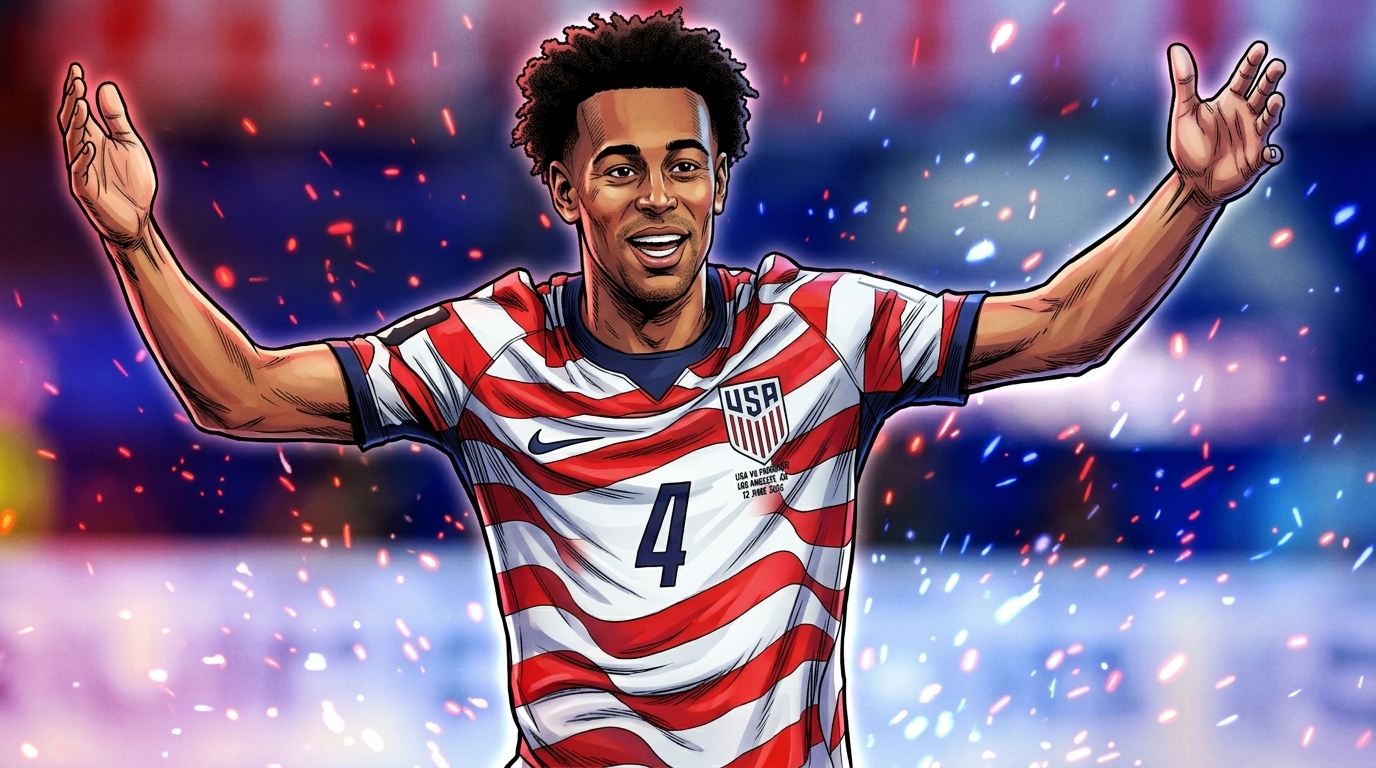
Yes, and it’s the third time in program history they’ve done it. The USMNT won Group D with six points through two matches, the highest points total through two World Cup games in program history, joining 1930 and 2010 as the only editions where they’ve topped their group. The back-to-back wins over Paraguay (4–1, SoFi Stadium, June 12) and Australia (2–0, Lumen Field, June 19) also mark the first consecutive World Cup victories since 1930. Ninety-six years between those two data points. This is a historic USMNT wins Group D 2026 World Cup moment whether American sports media chose to treat it that way or not.
The Paraguay result was emphatic. Damián Bobadilla put the ball into his own net in the 11th minute, Folarin Balogun added two more, and by halftime the match felt settled. Christian Pulisic — “Captain America,” the AC Milan winger who has become the face of this program — set up the first goal sequence before coming off at the break. Against Australia, without Pulisic entirely (calf injury, Ricardo Pepi starting in his place), the USMNT still won 2–0. Cameron Burgess turned another ball into his own net; Alex Freeman added the second before halftime. Group D was clinched when Paraguay beat Turkey 1–0 in the other match, pushing the USA through with a game to spare.
As Tim Ream, the captain, told Yahoo Sports: “There’s something about this one that just feels different…the way everybody meshes, it’s really enjoyable.”
Why Did American Sports Media Miss It?
The straightforward answer: because the USMNT wins Group D 2026 World Cup doesn’t fit into the machinery. The NBA Draft does. The draft is a pre-sold media event, contracted years in advance, assigned to broadcast teams, allocated ad inventory, distributed to every outlet that covers basketball (which is every outlet). The infrastructure builds itself twelve months out and arrives fully assembled. World Cup milestones don’t work that way. They happen when they happen, which is inconvenient.
I spent two years compiling notes for TV analysts who covered whatever was trending. I know exactly how that morning editorial meeting goes. (Nobody asked, “what did the USMNT accomplish last night?” They asked, “who’s our draft analyst calling in at 7?”)
CBS Sports ran a combined roundup headline that put the USMNT as a sub-bullet under Wyndham Clark winning the U.S. Open and the NBA Draft being “a day away.” Three stories, one digest. The golf got a full sentence. The draft got the headline anchor. The USMNT (historic qualifying result, on home soil, third time in program history) got a sub-bullet. This is not an editorial failure by one outlet. It’s a systemic one: the draft’s gravitational pull bent every sports desk in the country toward Brooklyn on June 23, and the USMNT’s moment got swallowed because it didn’t arrive on a pre-set calendar.
AJ Dybantsa going first to Washington, Darryn Peterson to Utah, Cameron Boozer to Memphis: these are real stories. The draft matters. The problem isn’t that it got coverage; it’s the ratio. When the history being made in Seattle gets less real estate than a mock-draft recap, you’ve told your audience something about which sport you think belongs.
What Does the NBA Draft’s Real Estate Say About Soccer’s Trajectory?
It says the bet is wrong, and Mauricio Pochettino told you so — politely, with a smile, in the most important sports media quote of the week.
“Now they realize that soccer here in America is massive, is big,” Pochettino said after the Australia result, per multiple outlets. “And be careful, other sports.”
That quote was written off as a coach doing coach things. It shouldn’t have been. Pochettino was named USMNT head coach in 2024 and given roughly two years to build something worth watching ahead of this tournament. What he built has now won six points in two World Cup matches (a program record) while the venues around it were full and loud in ways that weren’t guaranteed. The galvanization Pochettino is describing isn’t coming from television coverage. It’s coming from the stands.
“I am not American,” he told Yahoo Sports after Lumen Field emptied. “After the game, I was emotional. The fans were amazing…it was a perfect connection.”
https://twitter.com/USMNT/status/2068198694441357690
Tyler Adams put the depth argument in clearer terms than any analyst has managed: “The versatility of this team is insane…there’s guys that aren’t playing right now that can play a major role.” Pulisic missed the Australia match entirely and the USMNT still won 2–0. This is not a one-player team dependent on a single injury-prone winger. The program has depth, character, and a home-field setting it won’t have again for 32 years. The media apparatus that spent June 23 on the rights split between Fox and ESPN and draft boards is making an audience bet: that the soccer-watching public isn’t big enough yet to justify the column inches. That bet looks increasingly outdated. Fox Sports’s ad rates for the tournament are reportedly in the $2M+ per 30-second range if the USMNT makes a deep run, per Front Office Sports, because the tournament is in American time zones for the first time in three decades. The advertisers have already done the math. The sports desks are still catching up.
Meanwhile, the Golden Boot race that’s also being underreported is producing the kind of compelling individual narratives that American sports media loves when they happen in basketball or football. The audience is there. The stories are there. The editorial habit of treating soccer as a niche product inside a machinery built for draft days and playoff series is the one thing lagging behind.
What to Watch for in the Knockout Rounds
The USMNT faces Turkey on June 25 at SoFi Stadium (10pm ET), the final group game and effectively a preview of the knockout bracket mentality. Group D is already won, which means Pochettino will likely rotate, rest players including possibly Pulisic’s calf, and evaluate depth. What happens in that match matters less for the result than for the injury ledger heading into the Round of 32.
The Round of 32 is July 1 at Levi’s Stadium in Santa Clara, against a third-place team from Groups B, E, F, I, or J, a path that looks manageable if the bracket cooperates. Beyond that, a potential quarterfinal run would mean the tournament produces USMNT games deep into July on home soil, in American prime time, in sold-out stadiums. Fox has already priced that scenario. It exists in their revenue model.
The question is whether sports media builds the infrastructure to cover it properly before it happens, or whether the USMNT wins Group D 2026 World Cup and reaches the quarterfinals while a perfectly timed awards show or trade deadline chews up the column inches. Pochettino’s “be careful, other sports” wasn’t bravado. It was a projection. The audience is already there. The press corps is still running on draft-day autopilot.