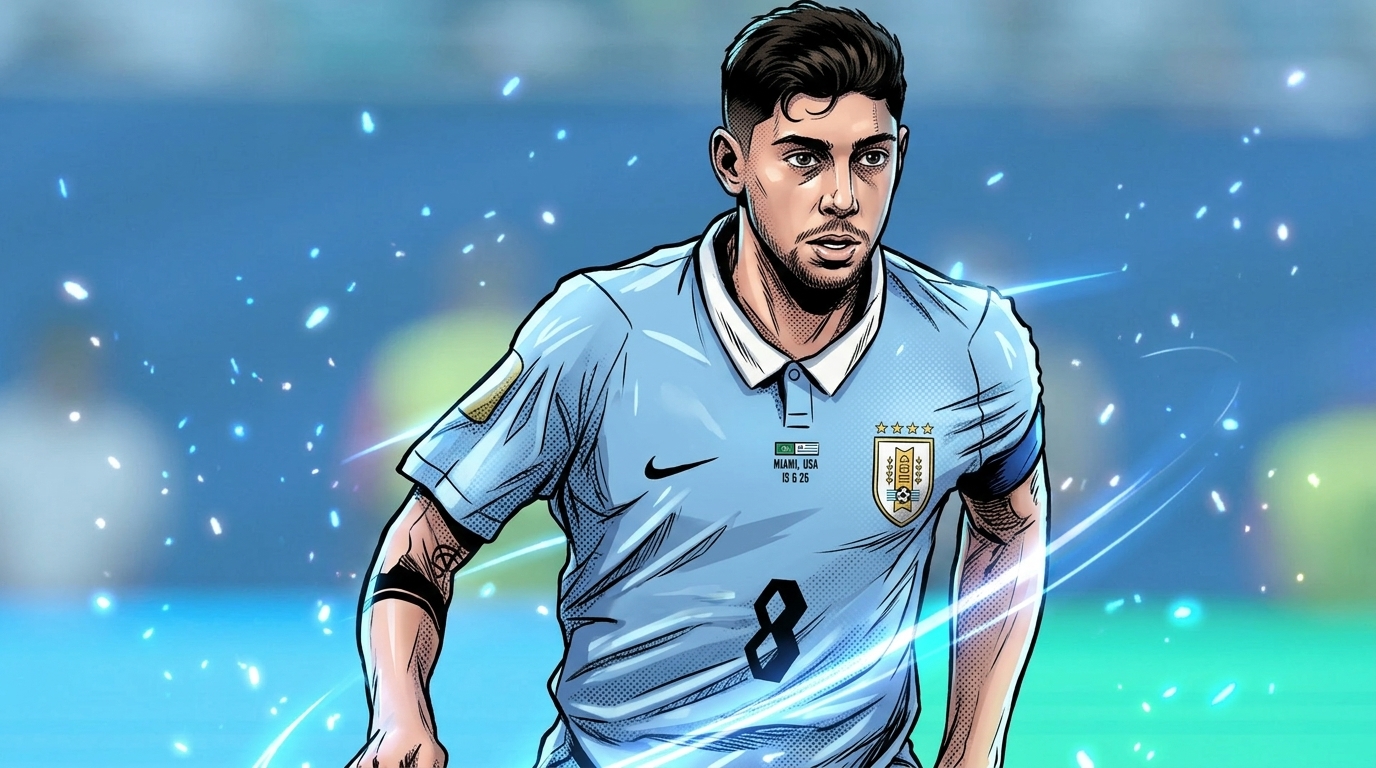

There is a single number that keeps following me around when I try to make sense of Uruguay’s World Cup: minus one. As in, Uruguay’s goal difference across three group-stage matches: three scored, four conceded, net negative. Three goals from a squad that deployed Federico Valverde in the Real Madrid engine room, Darwin Nunez leading Liverpool’s forward line, Manuel Ugarte at Manchester United, Giorgian de Arrascaeta at the heart of Flamengo, and Rodrigo Bentancur logging Premier League minutes at Tottenham. By any reasonable talent accounting, this was the deepest Uruguayan squad in a generation, maybe since the 2010 semifinalists. They finished third in Group H with two points. Cape Verde’s miraculous advancement came in their first-ever World Cup appearance; they finished with five points. Cape Verde had more points than Uruguay’s most talented squad in a generation.
The question worth investigating is not what went wrong in one game. The question is whether anything was ever going to go right given the specific combination of Marcelo Bielsa’s philosophy and this particular roster.
Why Did Uruguay Get Eliminated Despite Elite Talent?
Call it the Talent-to-Result Conversion Problem. Every coaching system has an implicit conversion rate: how reliably does elite individual talent translate into group-stage wins? Bielsa’s system, historically, has a conversion rate that depends on one precondition — unanimous buy-in. When that buy-in exists, his squads overperform on talent. When it fractures, the opposite happens. The philosophical intensity that makes Bielsa transformative in ideal conditions becomes a liability the moment players stop believing in the scaffolding.
Uruguay’s conversion rate at this tournament: 2 points from 3 matches, eliminated in the group stage for the second consecutive World Cup.
The fracture was not subtle. Before the Spain match, Federico Valverde, Rochet, Ugarte, and Bentancur approached Bielsa and asked him to switch to a low defensive block. They complained about excessive training loads causing injuries. Bielsa called a 48-minute team meeting, accused the players of trying to remove him, defended his philosophy. Some players walked out. Bielsa kept the system unchanged.
That is the context inside which Fernando Muslera stepped in front of an Alex Baena shot in the 42nd minute and batted the ball into his own net.
What Does the Data Say About Bielsa’s System vs. Uruguay’s Squad?
Bielsa’s system asks for something specific: high-pressing, high-line, positionally aggressive, physically brutal football. His teams run more. They press higher. They accept more risk in exchange for more control. Over a full season with club players who’ve trained his methods for years, that works. Over three years with a national team that assembles intermittently, with an aging goalkeeper and a captain who pulls double duty as both ball-carrier and defensive midfielder, the math gets harder.
Uruguay scored three goals in three World Cup matches and conceded four. Across the tournament’s expanded group-stage format, this kind of goal difference gets you eliminated even when you draw twice. Three goals. From a squad with Liverpool and Real Madrid forwards in the starting eleven, including a man who scored 19 goals in La Liga last season.
The system mismatch is not just philosophical; it is kinetic. Valverde at Real Madrid is asked to be a late-arriving midfielder, a box-to-box engine who reads the press and exploits it. Under Bielsa, Valverde was being asked to play as a high-pressing winger-midfielder hybrid that chewed through his legs. The training load complaints were not noise. Ugarte picked up a knee injury that ended his tournament on a stretcher. Valverde was substituted off at the 57th minute, having contributed less than any version of him his club managers have seen in years.
The talent-to-result conversion problem has a specific mechanism in this case: Bielsa’s system asked players to do work that was adjacent to but not identical to their best positions, and the physical cost of doing that work accumulated through a grueling training regime that the players themselves flagged before the decisive match.
That is not bad luck. That is a system that was never calibrated to the actual humans running it.
Was Bielsa Ever the Right Coach for This Roster?
This is the harder question, and the honest answer is: probably not, in hindsight, though the alternative was not obvious at the time.
Bielsa was hired in 2023 on the strength of his Chile and Argentina transformations, on his reputation as a coach who could take decent squads and turn them into something philosophically coherent and greater than the sum of their parts. Uruguay’s previous Copa América runs had been tactically competent but creatively limited. The federation wanted a visionary.
What they got was a visionary deployed onto a squad that already had its own internal logic. Valverde, de Arrascaeta, Nunez — these are players who have absorbed the tactical vocabularies of the best clubs in world football. They already had frameworks. They already had systems. Bielsa’s philosophy did not build on those frameworks; it required replacing them entirely with his own.
The 48-minute team meeting is the tell. Coaches who are correctly matched to their squads do not spend 48 minutes in the day before a World Cup elimination game defending their philosophy to their own captain. That meeting happened because the gap between what Bielsa was asking and what the players believed was right had grown wide enough that it required an emergency session to address. The gap had been growing for three years.
Valverde covered his face with his shirt on the bench after being substituted. The coaching staff physically intervened to calm him down. The video is difficult to watch.
https://twitter.com/PGonzalezMedia/status/2070728501745897930
That image is not a player reacting to one bad match. That is a player who poured everything into a system he was not sure he believed in, and watched it collapse anyway. The emotional weight of that moment is a data point. It tells you the strain predated June 26.
Marcelo Bielsa walked into the postgame press conference and said what very few coaches are willing to say: “What I gave Uruguayan football is nothing, because any contribution a coach makes to a national team over three years is futile without positive outcomes.” He also said, with characteristic precision, “We deserved seven points and only got two. Mistakes happen in football.”
Both statements are true simultaneously, which is what makes them so devastating.
He was wrong that he gave nothing. The system he built, however mismatched to these specific players, taught something. Uruguay’s pressing shape was more coherent in 2026 than it was in 2022. The problem is that philosophical coherence and group-stage advancement are not the same metric, and at a World Cup, only one of them matters.
The Talent-to-Result Conversion Problem does not care how elegant your press is. It cares whether the ball goes in the right net.
Uruguay’s next coach will inherit a squad that peaked in Valverde’s late 20s, with Nunez and de Arrascaeta still capable of decisive football, and Ugarte’s knee an open question. Spain’s group-topping run showed what is possible when a squad of comparable individual quality is deployed inside a system that fits the players rather than asking the players to fit the system.
Uruguay will need to find that fit. The talent is there. It was always there. The evidence now suggests that Bielsa, for all his brilliance, was never the man to unlock it — and the tragedy is that both he and his captain probably knew it by the time that meeting ended, 48 minutes into a conversation nobody wanted to have the night before everything fell apart.
The next three years are the question. The answer to that question will determine whether this generation of Uruguayan football is remembered as a failed experiment or as a foundation someone else finally built correctly.