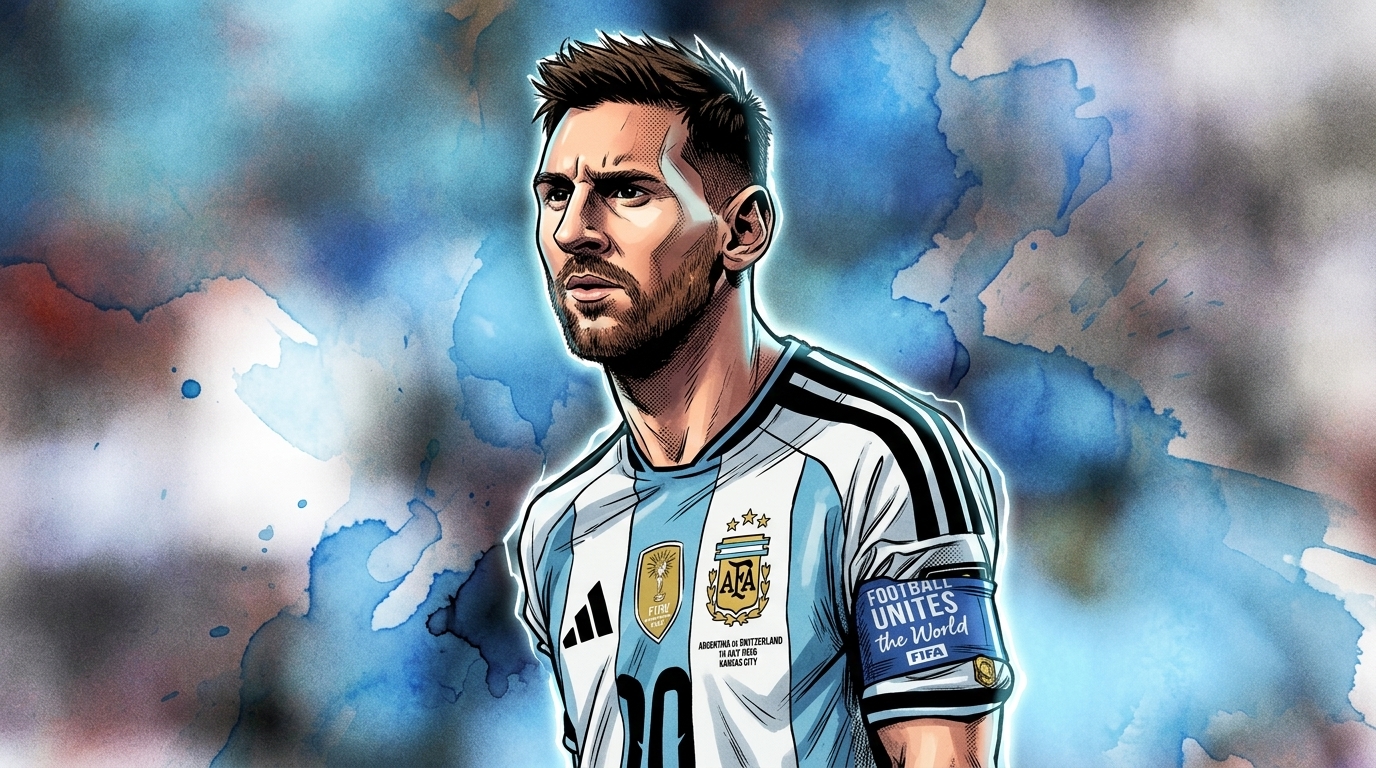

We’ve spent two years imagining what a Lionel Messi World Cup farewell would look like, and most of those daydreams involved something dramatic happening at his feet in the final minutes. Messi took the pitch for the final hours after Mbappe’s record chase became one of this tournament’s defining threads, and by the time the night at MetLife Stadium ended, Spain had beaten Argentina 1-0 in extra time to win the 2026 World Cup. The scoreline barely hints at how completely the sport’s greatest player disappeared inside his own final.
Messi recorded 15 touches in the first half and 54 across the entire match, with a single shot that Spain blocked and zero touches inside the box, per ESPN’s account of the final. We don’t usually file a stat line like that under a normal postmortem; it reads more like statistical erasure than a bad night. I think that’s the harder truth about how legendary careers actually end: diminished on the sheet, far more often than in the mythologized last stand we like to picture. Messi seemed to sense it before kickoff. He wore Adidas boots nicknamed “El Ultimo Tango” (The Last Dance, in English), a design built around the idea that this was his farewell tournament, modeled on the boots he debuted in at the 2006 World Cup. That framing wasn’t spin invented after a tough loss. It was stitched into his cleats before Argentina ever sang his name at MetLife Stadium.
This isn’t a novel pattern for sports’ biggest careers. The farewell we picture in advance is almost always the outlier, the storybook ending we remember disproportionately precisely because it’s rare. More often, the players who define an era leave the biggest stage the way Messi did here: surrounded, contained, and made ordinary by a younger opponent that scouted them for exactly this outcome. Spain didn’t need to beat Messi so much as make sure he never got a chance to beat them.
The game itself backs up the theory. Spain outshot Argentina 20-2, with twelve shots on target to Argentina’s zero (a gap wide enough to make the eventual scoreline feel almost merciful), and Spain didn’t concede a single goal across all eight matches it played at this World Cup. Coach Luis de la Fuente admitted the gameplan afterward: “The first idea was to keep Messi at bay,” he said, per ESPN. It worked. Argentina played a defensive approach of its own rather than opening up to chase the game, which meant Messi rarely saw the ball in space to do much with it. The winner arrived 37 seconds into the second period of extra time, Ferran Torres finishing a Nico Williams header that came off a Pedro Porro cross to end the match and Spain’s long wait for a second World Cup title.
This tournament produced no shortage of threads worth remembering on their own, from record chases to breakout teenagers to the best stories this tournament produced outside the final itself. Messi’s finish will be the one people argue about a decade from now precisely because it refused to give us anything to argue about in the moment. He had scored 8 goals and set up 4 assists across Argentina’s first seven matches, a case for one of the best World Cup runs of his career, at age 39, in what was already a men’s-record sixth appearance. Then, in the match everyone will remember, he barely touched the ball.
Messi cried after the final whistle and could hardly manage a smile even during the medal ceremony and Spain’s guard-of-honor for Argentina, per ESPN. Lamine Yamal was seen consoling him on the pitch, a small image that told you more about the mood than the trophy lift did. Messi later put it in his own words: “Yes… I cried. Not only because we lost a final, but because I know this is my last World Cup with the national team.” He added, “It’s very painful… honestly, it hurts a lot. I think the people of Argentina deserve more.” Coach Lionel Scaloni, who said he hadn’t yet discussed Messi’s international future with him, still offered the closest thing to an epitaph the sport will get: “I hope that everyone feels proud of him, of what he’s achieved, because he’s the best football player ever stepping foot on a pitch,” Scaloni said. The Argentine Football Association’s own message read like a farewell in itself: “Your tears are our tears, Captain… We love you forever, Leo.”
The image that traveled fastest afterward was Messi at the final whistle, and ESPN FC’s clip of the moment captured it about as well as anything did.
https://twitter.com/ESPNFC/status/2074556484864630805
Put plainly: Argentina didn’t lose the World Cup final in the way we usually talk about losing finals. Messi was quietly played off the pitch by a better team rather than going down swinging, and the box score backs it up: 54 touches, one blocked shot, nothing inside the area, across more than two hours. That’s not a tragedy. It’s just how legendary careers usually end when a better team beats a great one to the punch. The loss also denies Argentina back-to-back titles, extending a drought that already includes everyone else: no men’s national team has repeated as champion since Brazil in 1962.
What happens next matters more than what just happened. Scaloni hasn’t had the future conversation with Messi yet, at least not one he’s shared publicly (national federations are rarely in a hurry to make these things official), and Messi’s own words about this being his last World Cup with the national team sound less like grief-stricken hyperbole than a decision he’s already made peace with. If this really was the end, the boots got there before the scoreboard did. Watch for whatever Messi and Scaloni say once the tears dry, because that conversation will tell us more about Argentina’s next four years than a single extra-time goal ever could. Until then, the rest of our World Cup coverage has plenty more from a tournament that gave us this ending alongside a handful of new ones just getting started.