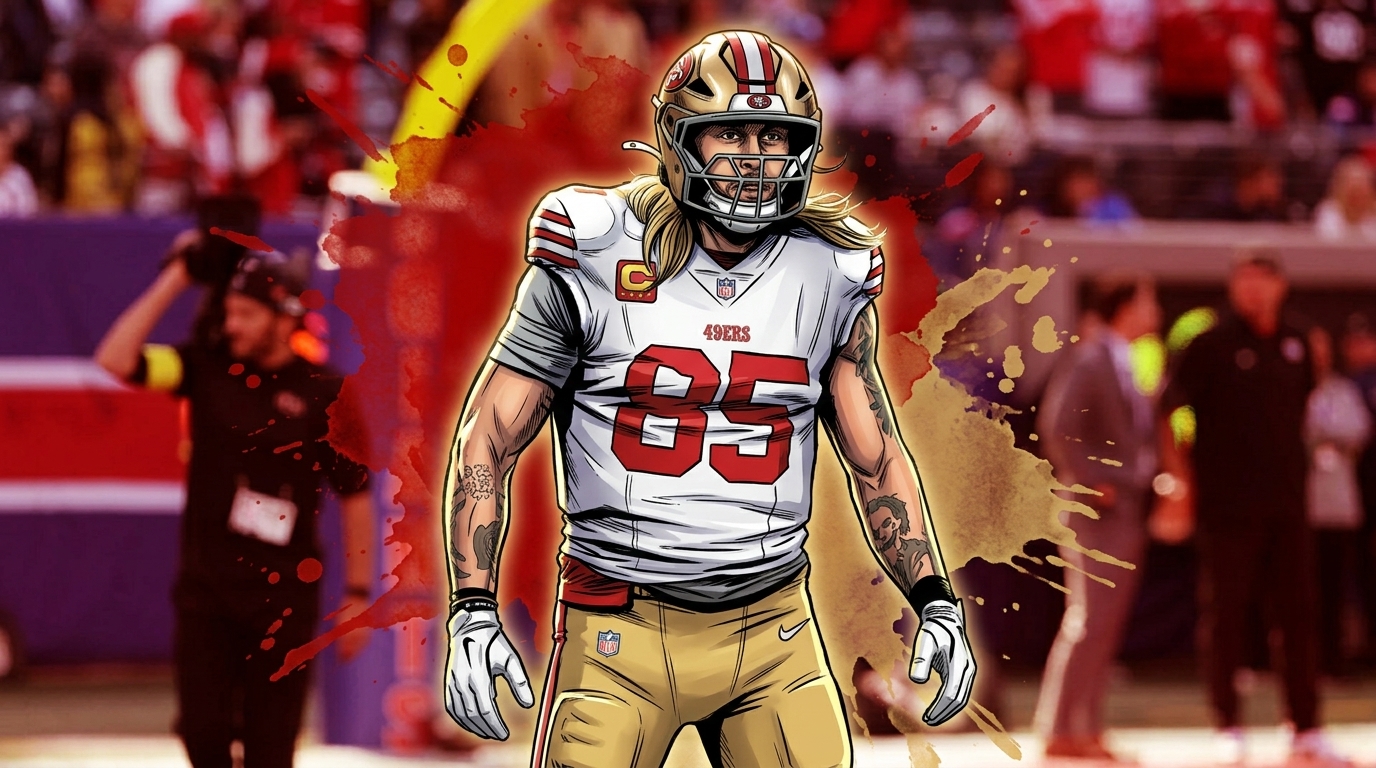

George Kittle squatted 665 pounds six months after tearing his Achilles, and the NFL has no injury protocol for whatever he is.
The video dropped July 17, posted by 49ers S&C coach Josh Cuthbert, and it shows Kittle loading a hex bar to 665 pounds, inhaling smelling salts like a man about to do something unreasonable, and then completing the lift. Yahoo Sports confirmed the weight. The standard orthopedic recovery window for an Achilles tear is 9 to 12 months, a number that exists because normal human tissue heals at a normal human rate. Kittle tore his right Achilles on January 11 during the Wild Card win over Philadelphia. Surgery was January 14. He is six months removed from the operating table.
What Does a 665-Pound Squat Six Months Post-Achilles Even Mean?
It means the recovery is not tracking on the expected curve. It is tracking on a different curve entirely. At OTA practice on June 3, NBC Sports Bay Area clocked him at 16 mph in cleats, a speed at which most Achilles patients are still in walking boots. He has described his trajectory as “fantastic” and said he is on track for Week 1. Week 1 is September 10, against the Rams in Melbourne, Australia. The first NFL regular-season game ever played in Australia, and Kittle has already decided he will be there.
The NFL’s Recovery System Wasn’t Built for This
Here is the thing the 665-pound squat actually reveals: the league’s entire injury infrastructure — PUP lists, return-to-play timelines, medical clearance protocols — was engineered around the average athlete’s healing rate. It was not engineered around George Kittle. Travis Kelce is the obvious comparison, another tight end who has rewritten the positional standard, but even that framing undersells what Kittle is doing right now. A 665-pound hex bar squat is not proof of a fast recovery. It is proof that the recovery framework was the wrong measuring stick to begin with.
The 49ers’ offense has always been built on Kittle’s specific freakishness: the blocking, the contested catches, the ability to punish safeties who think coverage is optional. Brandon Aiyuk benefits from defenses that cannot commit resources to stopping both of them simultaneously. That entire system depends on a human being who heals on a schedule the human body is not supposed to follow.
I have spent enough time reading orthopedic literature for journalism reasons to know that a clean, high-up soleus tear (which is what Kittle had) is the best-case Achilles scenario. But “best-case” in that literature still means 9 months minimum. The literature does not have a chapter for this.
The counterargument is that we should wait until he plays. One video from training camp is not a Week 1 guarantee. An Achilles can respond to controlled gym conditions differently than a full-speed NFL snap. That is a reasonable caveat.
It is also exactly the kind of caveat that gets abandoned the moment he runs a seam route past a linebacker in Melbourne, at full speed, less than eight months after surgery. When that happens, and the 665-pound squat strongly implies it will, every team in the league will look at their own injured tight end and start doing the math. Most of those players cannot do what Kittle does. The teams will try anyway.
The NFL’s injury timeline wasn’t designed to be broken. George Kittle wasn’t designed to care.