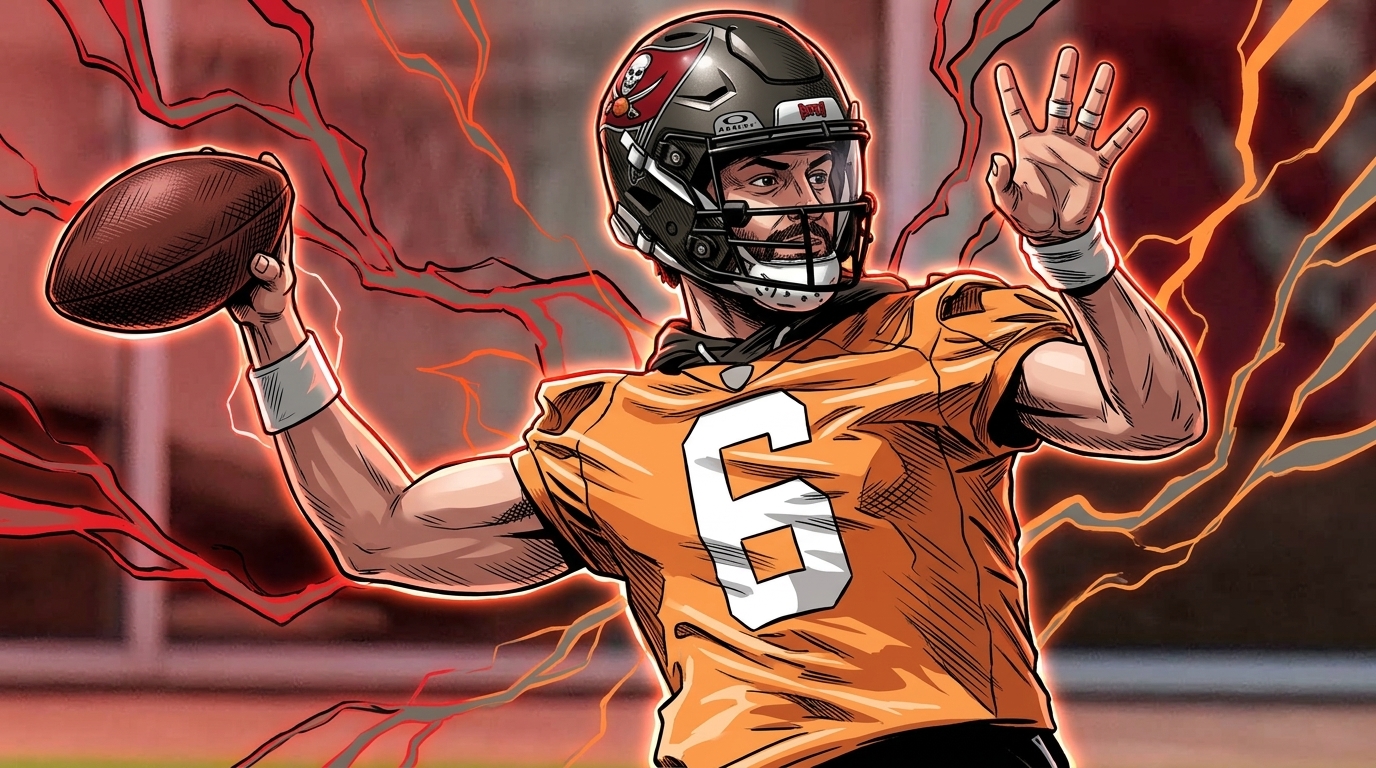

The NFL has a mechanism for handling quarterbacks who win in the wrong cities: it undervalues them until the contract runs out, then acts surprised when there’s a problem. We’ve watched this film enough times to know the sequence: the deadline, the gap, the public statements that say “we want him here” while the numbers say something else entirely. Baker Mayfield set a July 27 cutoff for contract negotiations with the Buccaneers. Training camp starts. The conversation either gets done before that, or it doesn’t happen until the season is over. NFL.com reported that Mayfield has made the terms clear: once camp opens, it’s football only.
The calendar isn’t the problem. The gap is.
Will the Buccaneers Get Baker Mayfield’s Contract Done Before Training Camp?
As of early July, the answer is almost certainly no. Rick Stroud of the Tampa Bay Times reported Mayfield’s own assessment in June: “Not anywhere close to what we were thinking.” Agents around the league put his market value at roughly $50 million per year. He’s currently earning $33.33 million annually, which ranks him 16th among NFL quarterbacks. The Buccaneers have shown no indication they’re prepared to close that distance in the next three weeks, and GM Jason Licht and HC Todd Bowles have confirmed the relationship is fine (the gap is financial, not personal, which in contract negotiations is almost the same as saying it’s personal).
https://twitter.com/gregauman/status/2062906047388319915
Mayfield’s position isn’t complicated. He’s under contract for 2026 (that part he’s acknowledged), but he’s made clear where his head is: “Would love to be here long term but as of right now that’s not exactly the case.” The Bucs restructured his deal to add $30 million in guaranteed money for 2026, which was meaningful but didn’t change the underlying math. A quarterback earning $33 million a year in a market where the floor for quality starters has moved significantly higher is, to use a technical term, getting shorted.
What the NFL’s QB Market Actually Says About Mayfield’s Ask
The current quarterback salary rankings on Spotrac tell a straightforward story. Dak Prescott is at $60 million annually. Josh Allen, Joe Burrow, Trevor Lawrence, Jordan Love, and Matthew Stafford are all at $55 million. Patrick Mahomes sits above all of them on his revised long-term deal. Mayfield, at $33.33 million, is not in this conversation — he’s separated from those names by a gap wide enough to drive a franchise through. His $50 million ask isn’t aggressive by the standards of that market; it’s a reasonable positioning at roughly 15-20 percent below the top tier, which is where a quarterback who has won consistently but hasn’t reached a Super Bowl as a starter should probably land.
The Bucs’ reluctance isn’t irrational on its own terms. Tampa went 8-9 last season and missed the playoffs for the first time since 2019. That record doesn’t force anyone’s hand. But it frames the situation in a way that obscures what the Bucs actually got from Mayfield over his first two seasons there: a functional, winning quarterback at a dramatically suppressed rate, allowing them to spend resources elsewhere. That discount has a shelf life, and the shelf life expires July 27.
The Mike Evans subplot is worth noting — if only because it reinforces the same pattern. Evans signed a three-year, $60.4 million deal with the San Francisco 49ers this offseason after the Bucs reportedly offered him more. He left for a new challenge, not more money. That’s a different conversation than Mayfield’s. But it means the Bucs are entering camp having lost their best receiver and still unresolved with their quarterback. That combination requires an explanation.
Why This Time the Deadline Is Real
Contract deadlines in the NFL are usually theater. Players say they won’t negotiate during the season; they negotiate during the season. Agents set artificial cutoffs; artificial cutoffs get extended. The NFL’s negotiating culture runs on stated positions nobody fully believes.
Mayfield’s deadline is different for a concrete reason: it’s not an invented date. Training camp opens July 27. His position: “as soon as training camp starts, we’re not doing any contract stuff — it’s all ball.” That isn’t a gambit designed to create urgency. It’s a statement about how he intends to operate professionally, and the two are different animals. The Bucs know this. They also know that if Mayfield plays out 2026 without an extension, he hits free agency with leverage the market will reward whether or not Tampa is involved.
Here’s what I think happens: the Buccaneers and Mayfield don’t get a deal done before July 27. Mayfield plays out the year, performs well enough to reset his market value above what the Bucs were offering, and the conversation in February looks completely different, except now the Bucs are negotiating from a weaker position. That is the predictable outcome of a franchise that has benefited from a quarterback’s under-pricing and chosen not to correct it while it had the chance.
The question for our NFL coverage going forward isn’t whether Mayfield is worth the money. He’s earned that argument. The question is whether the Bucs calculated correctly that waiting costs less than paying — or whether they’re about to learn what Tampa Bay looked like before Brady and Mayfield showed up to fix it. Three weeks to find out. Watch whether either side moves before the camp gates open, because once they do, this one goes on hold until January.
For everything else happening around the league this summer, follow along in our NFL section.