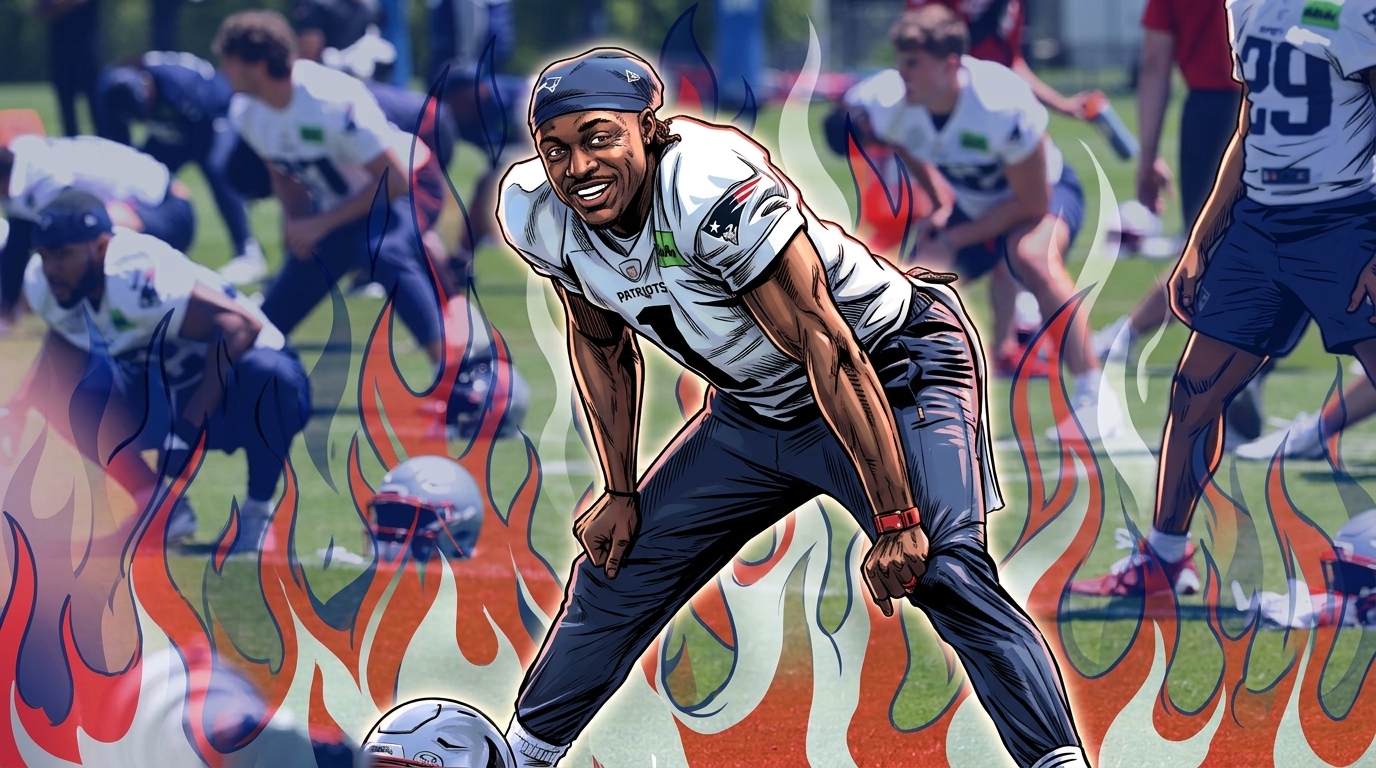

The trade has been in the air for weeks, and now it’s real: the Eagles sent AJ Brown to New England for a 2028 first and a 2027 fifth, timed post-June 1 to spread Philadelphia’s dead cap across two years. What Philadelphia is managing in cap accounting, New England is managing in urgency. Those are different kinds of transactions, even when the paperwork looks similar.
What Drake Maye just received is not a complementary piece. Brown has led the NFL in receptions (129) and receiving yards (1,977) against man coverage since 2022. He generated 37 first downs on plays where his quarterback was under pressure — the top mark in the league over that span. Last season, Maye ranked third in passing touchdowns against man coverage with 18, finished second in MVP voting, and went to the Super Bowl in Year 2. The Patriots are 23 years old and playing with the throttle open.
https://twitter.com/Patriots/status/2061878984439198077
Josh McDaniels described Brown at a press conference by reaching for a comparison that tells you everything about how seriously New England is treating this: “There’s a force to the way he plays the game. Maybe the closest thing I’ve seen is Gronk. This is a big guy.” That’s a specific kind of endorsement. McDaniels spent years building offenses around Rob Gronkowski. When he invokes Gronk to describe a wide receiver, he’s telling you what the system architecture is going to look like.
Brown’s own read on the situation was straightforward. He called it “heaven.” He said of Maye: “He can make any throw. He’s very poised.” Maye met him at OTAs and said, essentially, tell me where you want the ball. That is a functional working relationship being described in real time, and it matters more than it sounds. The Tyreek Hill arrival in Miami in 2022 is the closest structural parallel (major WR1 acquisition for a young quarterback), and the Dolphins went 8-3 with Tua starting that season. Brown is a more physical receiver than Hill and Maye is ascending faster than Tua was. The ceiling reference people are reaching for is Randy Moss to Brady in 2007. That comparison is asymmetric in an instructive way: Brady was already a three-time champion, Year 8. The Moss arrival didn’t create Brady’s greatness, it gave it a new gear. The question for New England is whether Maye is already close enough to that threshold for Brown to unlock something, or whether 2026 is still the season when the system learns to use the talent.
The infrastructure concern is real and worth naming. The cap mechanics of the deal leave New England carrying Brown at roughly $6.79M this year, which is efficient. The personnel concern runs elsewhere. Will Campbell, the fourth overall pick from 2025, allowed 14 pressures in Super Bowl LX — the most by any player in a single game all season. Maye was sacked 21 times in four playoff games. An anonymous NFL GM told Heavy that Maye is going to be “under a lot of pressure,” both literally and in terms of expectations. Brown is a safety valve for a pressured quarterback in a way most receivers aren’t, which is precisely why that 37-first-downs-under-pressure number matters so much. But you’d still prefer Campbell to be better. The offensive line is the variable this experiment cannot control.
Chicago is the control group. Chicago traded DJ Moore to the Bills in the spring for a 2026 second-round pick and cap relief. Williams said publicly he was sad to see him go but understood the business. Rome Odunze is coming off a stress fracture, and Luther Burden III is a developmental piece. The Bears’ philosophy is coherent on its own terms: build the system, develop from within, protect flexibility. It is also the opposite of what New England just did. Two franchises, two young quarterbacks with genuine franchise upside, one clear philosophical fork.
Bill Barnwell noted in his ESPN analysis that there’s no obvious winner or loser in the Eagles-Patriots exchange, pointing to Brown’s 4.7% career catch rate over expected across multiple quarterbacks as evidence of his independence from scheme. That’s a fair assessment of the trade in isolation. In context, it undersells what the Patriots are communicating. They’re acquiring the specific receiver who generates the highest defensive overhead of any skill player in the AFC, the one that forces coordinators to account for on every down, the one whose routes make everything else easier because every safety in the building knows where he is. The cap number is $6.79M. The actual cost is that every defense now has to build its week around him.
Brown reconnects with Mike Vrabel, who coached him in Tennessee from 2019 to 2022. McDaniels is back at offensive coordinator. Maye enters Year 3 with a legitimate offensive infrastructure and a quarterback-receiver relationship that formed, by all accounts, immediately. What to watch: whether Campbell stabilizes the left side enough to let the passing game operate at full efficiency, and whether the Bears’ bet on internal development looks prescient or costly by November. Those two storylines will define the 2026 NFC North and AFC East simultaneously. Right now, one franchise has dramatically more to show — and the other one is Chicago.