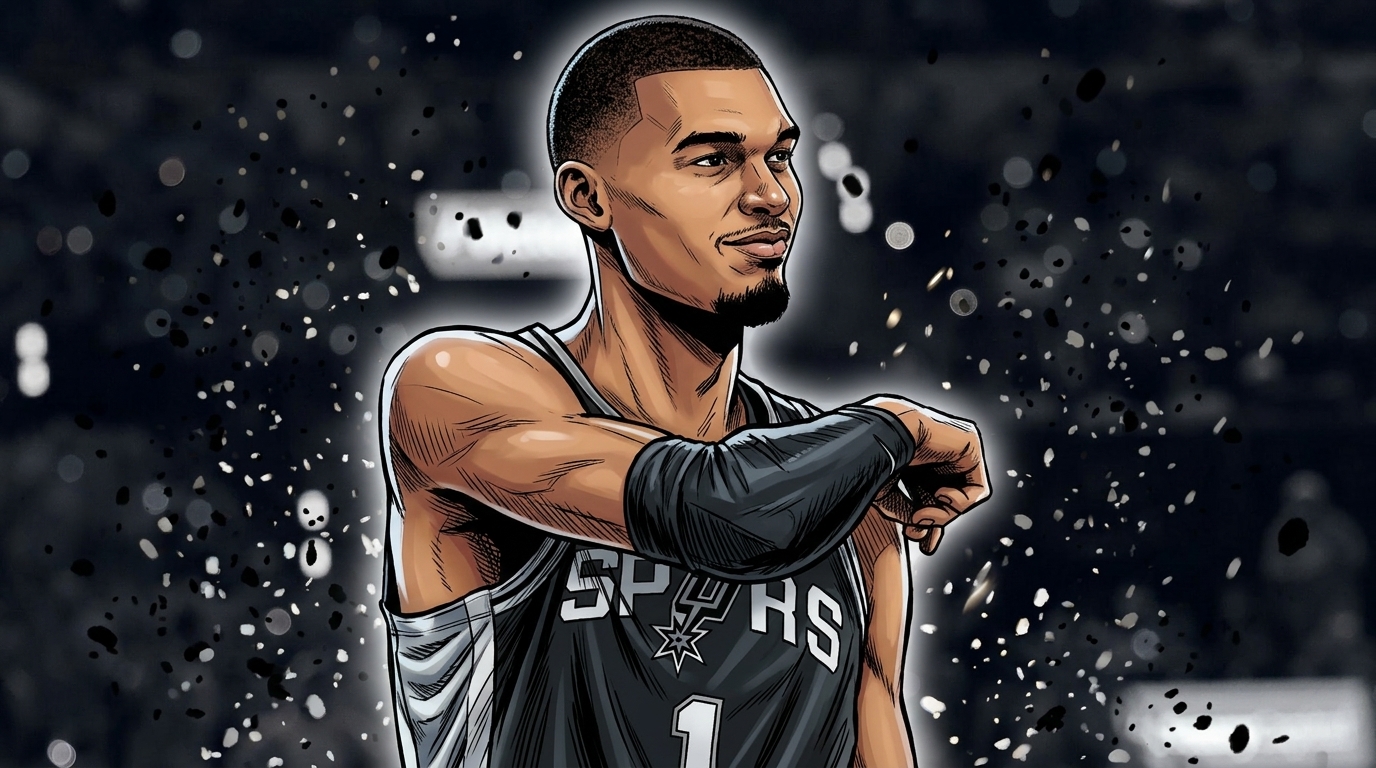

Here is what the Finals MVP market knew going into Game 1: Victor Wembanyama was the -185 chalk, per DraftKings. Jalen Brunson was the +210 underdog. The Knicks had just survived a brutal seven-game Eastern Conference run, while Wembanyama had posted 30-plus points in four consecutive games against OKC in the Western Conference Finals. The math seemed obvious. The market priced it accordingly.
Then the Knicks’ championship run happened.
Brunson scored 45 in Game 5, went 13-for-15 from the free-throw line, and closed a 4-1 series that the Spurs had somehow built double-digit leads in four of five games, per covers.com. He averaged 32.6 points, 4.6 assists, and 4.2 rebounds across the series. All 11 Finals MVP voters gave him the trophy unanimously. The market that had priced Wembanyama as a near lock settled on a +210 underdog.
https://x.com/NBA/status/2066010676892426342
That gap — between what the market priced and what the market actually paid — is the most useful signal in NBA futures right now. And it points directly at the 2026-27 NBA championship odds.
The Settlement Price Test
In financial markets, the settlement price is the number that matters. Not what you paid in. Not what the position looked like at halftime. What it actually closed at. The gap between the pre-series price and the settlement price tells you where the market got it wrong.
I call this the Settlement Price Test, and it works in sports futures the same way it works on a trading desk.
The Finals MVP market failed the test badly. Wembanyama at -185 implied a roughly 65% win probability. Brunson at +210 implied about 32%. The market gave Brunson less than one-in-three odds and he won unanimously. That’s not a close call that went the wrong way. That’s a mis-pricing. The market was anchored to Wembanyama’s regular-season numbers (25.0 PPG, 11.5 RPG, 3.1 BPG) and his WCF MVP performance and forgot to account for what happens when a player his size meets Brunson’s pick-and-roll volume at full Finals intensity.
Now apply the same test to the 2026-27 championship odds, currently posted by DraftKings. The San Antonio Spurs are co-favorites at +250. The OKC Thunder are right behind at +260. The Boston Celtics sit at +550. And the New York Knicks, the team that just finished hoisting the trophy, are priced at +650 to repeat.
The settlement price on the 2026 Finals was Brunson and New York. The futures price for 2027 already has two teams priced ahead of them. Run the Settlement Price Test on that, and the signal gets loud.
Why Are the Spurs Favored Over the Defending Champions?
The short answer: Victor Wembanyama is 22 years old and turns 23 in January. Jalen Brunson is 29, turning 30 in August. Karl-Anthony Towns is 30, turning 31 in November. OG Anunoby is 28. Age curves in the NBA are not subtle. They are among the most reliable predictors in all of sports analytics, and the gap between the Spurs’ age profile and the Knicks’ age profile is closing fast at the top of the roster.
The longer answer involves what Wembanyama actually showed across this postseason. He averaged 25.0 points, 11.5 rebounds, and 3.1 blocks per game in the regular season’s closing stretch. The Minnesota Timberwolves held him to 19.8 PPG in a six-game conference semifinal (a legitimate defensive achievement) but he still posted a WCF MVP in seven games against OKC. The Spurs also play Stephon Castle (21, turns 22 in November) and Dylan Harper (20, turns 21 in March 2027). The Knicks play Brunson, Towns, and Anunoby.
The market is not betting on who won. It is betting on who ages better. Over a full season, the Spurs are the safer side of that trade.
There is also the matter of what almost happened. San Antonio built double-digit leads in four of five Finals games, per covers.com. The Knicks won three of those on late-game execution: Brunson’s free-throw dominance (13-for-15 in Game 5 alone) and a defense that tightened in the fourth quarter when it counted. The Spurs were not outclassed. They were outlasted. At +250, with a year of additional development, that is a relevant distinction.
The Knicks Window Is Older Than You Think
Here is the number that should give Knicks fans pause: +650.
The Knicks are the defending champions and the fourth most likely team to win the title next year, per DraftKings. Behind the Spurs. Behind OKC. Behind Boston.
Woof.
The 2026-27 NBA championship odds have the team that just beat everyone priced as a significant long shot to do it again. That is not reflexive market pessimism. The Celtics were -115 to repeat after their 2024 title and they failed to get back. Defending champions face a structural disadvantage in futures markets because everyone around them gets a full offseason to adjust while the champion’s core ages another year.
The Knicks’ core ages poorly. Brunson at 30 going into next season is still elite, but he just played the most minutes of any point guard in this postseason cycle. For more NBA betting analysis, the context is this: high-minute playoff guards entering their 30s have a steeper attrition curve than the celebration coverage tends to acknowledge. Towns is entering his age-31 season with a physical style that has historically accelerated decline. The team maxed out its roster flexibility getting to this configuration. The championship window is not closed. It is just narrower than the celebration suggests.
Contrast that with Spurs at +250. Wembanyama’s age-23 season historically tracks with the year players of his archetype take a second leap. Hakeem Olajuwon’s age-23 season. David Robinson’s age-24 season. The comps are imperfect but the trajectory is not random. Big, skilled centers who can pass and block shots at elite rates tend to get better in their mid-twenties, not worse. Castle and Harper are both still on rookie contracts. The Spurs have margin for error the Knicks simply do not possess.
The Wildcard That Could Scramble the Board
The NBA Draft runs June 23-24. More importantly, Giannis Antetokounmpo’s trade situation has reached the point where multiple teams are treating it as a near-certainty that he moves this summer. The market has not fully priced a Giannis landing spot into the 2026-27 NBA championship odds yet because nobody knows the destination.
If Giannis lands with OKC, the Thunder become -150 chalk overnight. If he goes to Boston, the Celtics close from +550 to the neighborhood of +280. If he goes anywhere near a contender, the current board becomes functionally obsolete by mid-July.
The Spurs are largely insulated from this wildcard. They are not a Giannis destination. Their timeline is younger than he wants, their cap situation is complex, and Wembanyama’s development curve does not need an aging superstar layered on top of it. That insularity is a feature, not a bug, when you are pricing futures into an offseason with a major market-moving player in motion. The Spurs’ +250 is a price that survives most versions of where Giannis lands. OKC at +260 might not.
I ran the Settlement Price Test three ways: against the Finals MVP market, against the historical age curves for both rosters, and against the Giannis-adjusted probability tree. All three point in the same direction.
The market priced Wembanyama as the favorite before the Finals and was wrong. Now the 2026-27 championship odds price the Spurs as the favorite going into next season, and the underlying data supports it. Young core. Best player in the series who lost. A year of development on the right side of the aging curve.
Give me Spurs +250.