
The NFL spent last week proving exactly how it grades risk: cancel the stuff that costs nothing to cancel, and send the actual nationally televised Steelers-Saints game into the middle of it anyway. I can’t get over how transparent the math was. A league that markets itself as obsessively safety-conscious looked at roughly 110,000 people in the streets of the same city hosting its game and decided the right response was to shut down a merch tent.
The plain accounting: the NFL canceled or quietly shelved its Paris fan events over the protests, and left the actual game exactly where it was on the schedule. The league sorted its Paris commitments into what it could afford to lose and what it couldn’t afford to touch. The one commitment with broadcast partners, international rights fees, and years of investment in selling American football as a global product never got anywhere near the cancellation list.
NFL House, the league’s flagship fan activation site, closed Saturday over what the league’s OnePass app called “potential accessibility issues,” a notice that arrived one day after the league quietly shuttered its city-center pop-up shop for the identical reason. The Steelers canceled their own “Steelers House” fan weekend outright, citing security concerns. The Saints didn’t get the same treatment: their event, “Saints House,” was only postponed to Sunday.
Here’s who the league decided was an acceptable level of exposure: two full rosters, their families, the traveling staff who handle the logistics, and the 78,488 fans who bought tickets and showed up at Stade de France anyway. Pittsburgh beat New Orleans 16-10. Nobody in that stadium got hurt. Credit for that belongs to French riot police and the NFL’s own security operation, not to a risk calculation the league got to make with other people’s families on the line.
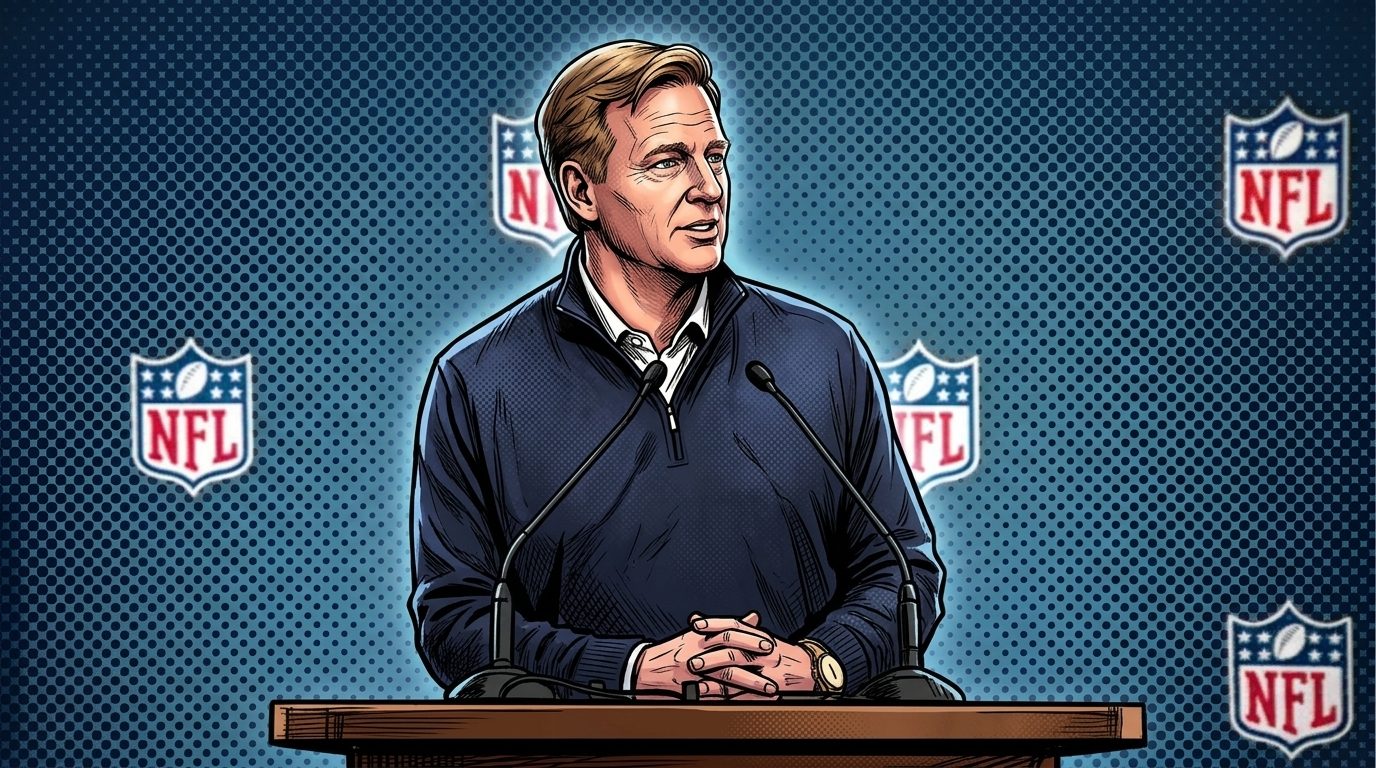
Commissioner Roger Goodell told reporters his “comfort level” with the security plan was very high, pointing to coordination with the U.S. State Department and French authorities. “Protests are not unusual in France,” he added. That’s true. It’s also not the question anyone was asking him.
The league’s statement never wavered from one note, repeated almost verbatim by every spokesperson who got asked about it:
“Preparations continue as scheduled for NFL events and the game at Stade de France next Sunday… There’s been no disruption or impact at league sites.”
Saints spokesman Greg Bensel echoed the same line about the team’s own facilities and said security staff had already been on the ground in France for days. No disruption, the league kept repeating, which is bullshit, and everyone covering this story knew it the moment NFL House went dark over “potential accessibility issues” it never bothered to define.
The unrest wasn’t theater for the cameras. Police estimated 110,000 people marched in Paris alone on Saturday, part of a nationwide count near 410,000, with organizers putting the real number closer to 800,000 and roughly 1,000 arrests by the end of the day. Masked demonstrators threw fireworks at police near the march’s endpoint. Police answered with tear gas, sound grenades and water cannon. The Louvre and the Orsay shut their doors. Storefronts across the city got boarded up.
Adam Schefter captured the league’s posture about as well as anyone:
https://twitter.com/AdamSchefter/status/2111839653959540753
“Despite intense riots and social unrest,” he wrote, “the NFL says the game is on.” A professional sports league needed that sentence construction to describe whether its own game would happen, and that tells you where Paris actually stood that weekend.
Even Donald Trump thought this was overkill, telling reporters Friday he was “worried” about the Paris game and that the NFL “could’ve probably postponed” it. French President Emmanuel Macron called the comments “unacceptable and even stupid,” accusing a foreign head of state of exploiting France’s crisis for political gain. I don’t say this often, but Macron had a point — even though Trump’s instinct about the actual danger was right for the wrong reasons.
None of this should surprise anyone who has watched the same league office that fought to bury its own report cards make calls about what gets disclosed and what gets buried. The instinct is always the same: protect the asset, manage the message, worry about the humans attached to either one last.
It’s the oldest instinct in institutional budgeting: nobody cancels the line item that makes money. They cancel the one that doesn’t. That’s why a merch tent and a fan house got the axe while two teams still flew to Paris. You don’t postpone the thing you built the trip around. You postpone the stuff orbiting it.
Yahoo Sports caught the NFL House closure as it happened:
https://twitter.com/YahooSports/status/2113971815601066396
A merch tent went dark that afternoon. The kickoff clock never moved.
The Steelers left Paris with a 16-10 win in the books. The Saints left having watched their own fan house get bumped a single day while the league treated its merchandise inventory with more urgency than it treated the players and staff it actually sent into the unrest.
The NFL will insist it never compromised on safety. Technically, in the narrowest and most self-serving reading of that sentence, it’s correct: the league never compromised on the safety of the thing that pays its bills. Everything else in Paris was negotiable days before kickoff.