MLB All-Time Hits
Pete Rose leads MLB with 4,256 career hits, 67 ahead of Ty Cobb. The all-time hits leaderboard, the record's history, and who ranks behind them.
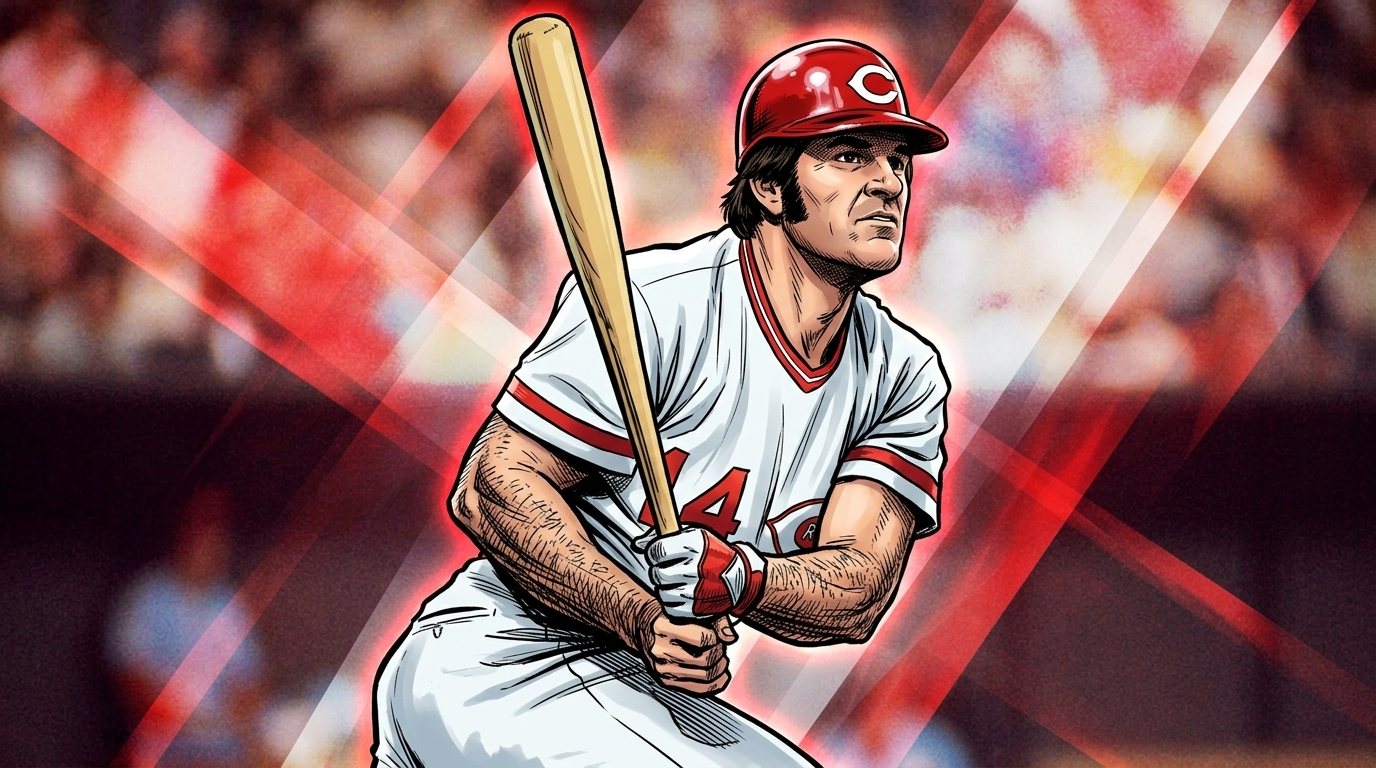
Pete Rose is Major League Baseball’s all-time hits leader with 4,256, a total he closed out in 1986 and that no one has approached since. As of October 14, 2026, Rose sits 67 hits clear of Ty Cobb, the man he passed in 1985, and the two of them remain the only players in the sport’s history to reach 4,000. Rose died on September 30, 2024, and the record he holds has outlived every serious challenge to it; the chase now is not for the top of the list but for the 3,000-hit threshold far below it.
The leaderboard
| Rank | Name | Hits | Team(s) / Years |
|---|---|---|---|
| 1 | Pete Rose | 4,256 | Reds, Phillies, Expos (1963–1986) |
| 2 | Ty Cobb | 4,189 | Tigers, Athletics (1905–1928) |
| 3 | Hank Aaron | 3,771 | Braves, Brewers (1954–1976) |
| 4 | Stan Musial | 3,630 | Cardinals (1941–1963) |
| 5 | Tris Speaker | 3,514 | Red Sox, Indians (1907–1928) |
| 6 | Derek Jeter | 3,465 | Yankees (1995–2014) |
| 7 | Cap Anson | 3,435 | Chicago NL (1871–1897) |
| 8 | Honus Wagner | 3,420 | Colonels, Pirates (1897–1917) |
| 9 | Carl Yastrzemski | 3,419 | Red Sox (1961–1983) |
| 10 | Albert Pujols | 3,384 | Cardinals, Angels, Dodgers (2001–2022) |
| 11 | Paul Molitor | 3,319 | Brewers, Blue Jays, Twins (1978–1998) |
| 12 | Eddie Collins | 3,315 | Athletics, White Sox (1906–1930) |
| 13 | Willie Mays | 3,293 | Giants, Mets (1951–1973) |
| 14 | Eddie Murray | 3,255 | Orioles, Dodgers, others (1977–1997) |
| 15 | Nap Lajoie | 3,243 | Phillies, Athletics, Cleveland (1896–1916) |
At a glance
- 1st Career hits, MLB history (4,256)
- 1st Career games played (3,562)
- 1st Career at-bats (14,053)
- 1st Career singles (3,215)
- All-time MLB hits leader
- 3× World Series champion
- 1973 NL MVP
- 1963 NL Rookie of the Year
- 17× All-Star
- 3× NL batting champion
Per Baseball-Reference and the MLB career records list, through October 14, 2026.
The chase
No active player is realistically chasing Rose, and the honest version of the chase is for the territory well beneath him. Freddie Freeman is the active hits leader with 2,598 as of September 27, 2026, having become the only active player to reach 2,500 when he crossed that line in June 2026, per MLB.com. Jose Altuve sits second among active players at 2,519, with Andrew McCutchen and Paul Goldschmidt clustered near 2,280.
The arithmetic ends the conversation quickly. Freeman, who turned 37 in September 2026, would need roughly 1,658 more hits to pass Rose — more than a full Hall-of-Fame career’s worth, piled on top of the one he has already had. Even the nearer milestone is a reach: the 3,000-hit club has stood at 33 members since Miguel Cabrera joined it on April 23, 2022, and Freeman remains the active player best positioned to become the 34th. The top of the all-time hits list, in other words, is not a live leaderboard so much as a settled one. Rose’s number has been fixed since his final plate appearance in 1986, and the structure of the modern game — shorter careers, higher strikeout rates, specialized bullpens — makes a four-decade pursuit of 4,256 harder now than it was when Rose built it.
How it’s measured
A hit is credited by the official scorer whenever a batter reaches base safely on a fair ball without the benefit of an error or a fielder’s choice, and the career total is simply the sum of a player’s regular-season singles, doubles, triples and home runs. That definition sounds clean, but it papers over why totals from different eras do not sit on the same shelf. Cap Anson’s line stretches back to 1871 and the National Association years, a period some record-keepers include and others do not, which is why his career figure varies by source. Nineteenth-century schedules ran well short of today’s 162 games, the pitching distance and rules changed repeatedly, and the dead-ball era that shaped Cobb, Speaker, Wagner, Collins and Lajoie rewarded a contact-and-speed style that produced gaudy hit counts alongside modest power.
Longevity is the other hidden variable. Rose reached 4,256 across 24 seasons and a record 3,562 games, the most anyone has ever played, along with the most at-bats (14,053) and the most singles (3,215). The record is as much a monument to durability and plate appearances as it is to any single season of brilliance — Rose’s single-season high was exactly 230 hits, reached in his 1973 MVP year, never the 240-plus outlier seasons some of the men behind him produced, but he banked 200-hit seasons at a rate few could sustain for as long as he did.
The arguments
The list carries more debate than almost any other in baseball, and the first argument is about the man at the top. Rose was banned from the sport for life in 1989 over gambling and, for decades, that ban kept him off the Hall of Fame ballot even as his name sat first in the record book. Commissioner Rob Manfred ruled in May 2025 that permanent ineligibility ends when the disciplined individual dies, which made the posthumous Rose eligible for consideration; the Hall has indicated his case would fall to the Classic Baseball Era Committee on a 2027 ballot. Supporters hold that the record and the enshrinement are separate questions; critics counter that the ban was the point, and that eligibility arriving only after death resolves nothing cleanly.
A second argument is methodological: a counting stat rewards accumulation, not peak quality. Cobb retired with a .366 career batting average, the highest in history, across roughly 500 fewer games than Rose — 3,034 to Rose’s 3,562 — and the rate-versus-volume camp argues that “best hitter” and “most hits” are not the same claim. A third argument is about the record’s boundaries. Ichiro Suzuki, elected to the Hall of Fame in 2025, collected 3,089 hits in MLB after beginning his career in Japan; counting his roughly 1,278 Nippon Professional Baseball hits pushes his professional total past Rose’s, a comparison Rose himself publicly rejected. MLB’s record book counts only games played in the major leagues, so Ichiro ranks 25th on the official list while the “most professional hits” debate lives on outside it.
Per Baseball-Reference, Wikipedia's career hits list, and PBS NewsHour, through October 14, 2026.
Why it matters
Hits are the oldest common currency in baseball, the number a fan reaches for first when arguing who could flat-out play, and the career leaderboard is where that currency compounds across a century and a half of the sport. It rewards the thing hardest to fake — showing up, day after day, and putting the ball in play better than the field — which is why Rose’s 4,256 has become shorthand for relentlessness itself. That the man who holds it spent most of his life outside the Hall of Fame only sharpens the list’s hold on the argument: the record and the reckoning around it are, in the end, the same story, and it is still the one that ends every group-chat debate about who got the most hits.